Key takeaways
- Framer is a design-first, no-code website builder, and its AI agents generate pages, layouts, copy and visuals on an editable canvas.
- AI also writes code components, manages the CMS, audits sites for accessibility and SEO issues, and translates content.
- Output is visually polished — Framer’s design pedigree shows — and everything stays editable by conversation or by hand.
- Best for designers, startups and teams who want high design quality with AI speed.
What Framer is
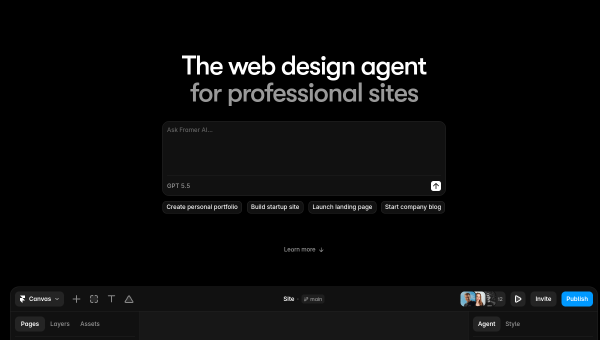
Framer is a design-first, no-code website builder that has become a favourite of designers and design-conscious startups for the visual quality of the sites it produces. Its AI layer adds agents that automate site creation and maintenance: you describe what you want, and the AI generates pages, layouts, copy and visuals directly on Framer’s canvas, all editable and refinable through conversation or manual design. The key difference from generic AI builders is Framer’s design pedigree — output tends to look genuinely polished rather than templated.
That aesthetic edge is the reason to choose Framer. Where many AI builders produce functional-but-plain sites, Framer’s combination of a strong design tool and AI generation aims at sites that look professionally designed, which matters for brands, portfolios and product marketing pages.
The AI features
Framer’s AI generates pages from prompts into editable sections and visuals, and assists with layout and design — typography, spacing, colour. It can write code components for custom effects and interactions, manage the CMS to organise and sync content with design, and audit a site to flag contrast issues, typos, missing alt text and SEO gaps. It also interprets analytics into actionable insights and translates content across languages. This is a broad set that spans creation, maintenance and optimisation, not just initial generation.
The site-auditing and code-component features are especially useful: catching accessibility and SEO problems automatically, and generating custom interactions without hand-coding, add real value on top of generation. As always, generated designs and copy need review, and AI-written code should be tested before it ships.
Strengths and limits
The strengths are design quality and breadth of AI help. Framer produces some of the best-looking AI-assisted sites available, and its AI covers the full lifecycle — build, maintain, audit, optimise, translate. Everything stays editable, so you are never trapped by the AI’s output. For designers and design-led teams, it hits a sweet spot others miss.
The limits: Framer’s design-first nature and pricing suit brand sites, portfolios and marketing pages more than large, complex web applications or heavy ecommerce. There is a learning curve to using it well — it is more capable, and so slightly more involved, than the simplest builders. And AI-generated design still benefits from a designer’s judgement to be truly distinctive.
Who it suits
- Designers and design-conscious startups who want polished, distinctive sites.
- Teams building brand sites, portfolios and product marketing pages.
- Users who want AI help across building, auditing and optimising a site.
Verdict
Framer AI stands out for design quality: it brings AI generation to a genuinely excellent design-first builder, so the sites look professionally crafted rather than templated. Its AI spans the whole lifecycle — generating pages, writing code components, managing the CMS, auditing for accessibility and SEO — while keeping everything editable. It is best for brand sites, portfolios and marketing pages rather than complex apps, and its output still rewards a designer’s eye. For anyone who cares about how their site looks, Framer is one of the best AI-assisted choices available.
Top Framer AI alternatives
Other hand-reviewed No-Code tools worth comparing against Framer AI.
10WebPaid
10Web is a paid AI no code and website builder tool for founders and small businesses. Our review…
AdaloPaid
Adalo is a paid AI no code and website builder tool for non-technical builders. Our review covers what…
Bravo StudioFreemium
Bravo Studio is a freemium AI no code and website builder tool for non-technical builders. Our review covers…
BubbleFreemium
Bubble is a freemium AI business and no code tool for non-technical builders. Our review covers what it…
FlutterFlowPaid
FlutterFlow is a paid AI no code and website builder tool for founders and small businesses. Our review…
GlidePaid
Glide is a paid AI no code and website builder tool for non-technical builders. Our review covers what…
Are you the maker of Framer AI?
Show visitors this review with the badge below. Copy the code into your site or press kit; it links straight back to this page.