Key Takeaways
- Ellipsis is a cloud platform for running autonomous coding agents at scale.
- You define agents in YAML, deploy them via git push, and monitor their work.
- It offers isolated sandboxes, scoped permissions, budget caps, and audit trails.
- Great for engineering teams automating code review, PRs, and routine dev tasks.
Ellipsis is built for teams that want to put AI coding agents to work reliably — not just in one editor, but across their repositories and workflows. You define agents in YAML, deploy them with a git push, and Ellipsis runs them in isolated sandboxes with scoped permissions, budget caps, and full audit trails. For engineering teams that want automated code review, PR handling, and routine tasks with guardrails, it brings the control that ad-hoc AI tooling lacks.
What is Ellipsis?
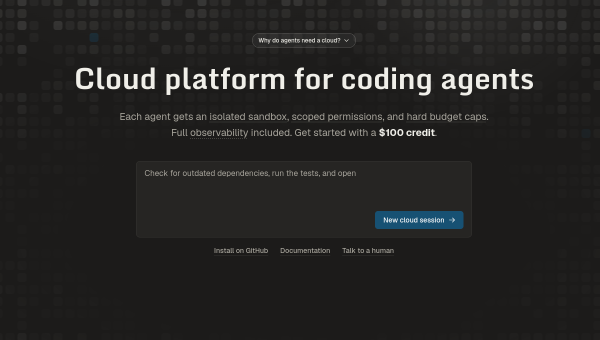
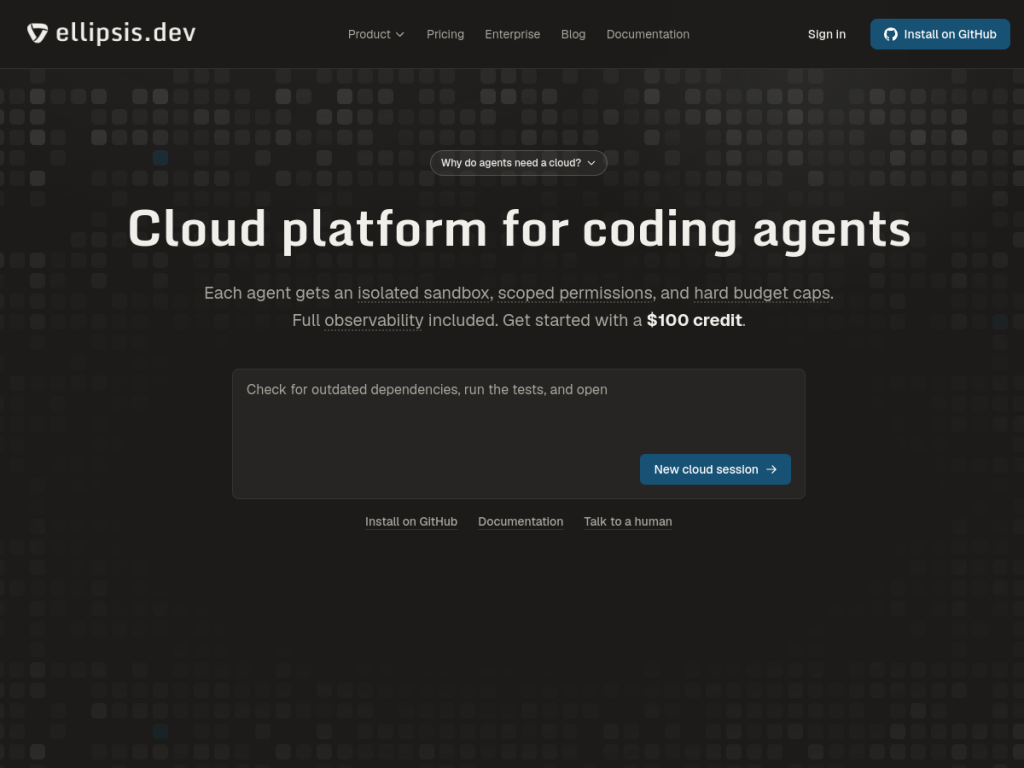
Ellipsis is a cloud platform designed to manage and run autonomous coding agents at scale. Teams define AI agents in YAML, deploy them via git push, and monitor their activity across repositories. Its emphasis is on control and safety: each agent session runs in an isolated sandbox with scoped permissions and credentials, hard budget caps (per-session, daily, and monthly), and full observability with audit trails. It supports leading models — including Claude, Codex, and Gemini agents — and functions as an AI code review and PR bot system, letting agents perform automated code reviews, merge-related tasks, and PR management. Agents can be triggered by cron schedules, events from GitHub, Linear, Slack, and Sentry, or by @-mentions across those platforms. The company is Y Combinator-backed and SOC 2 certified, reporting millions of agent sessions across hundreds of engineering teams. New users get a starting credit, with paid plans scaling by usage.
What it does well
- Agents as code: define agents in YAML and deploy via git push.
- Safety controls: isolated sandboxes, scoped permissions, and budget caps.
- Observability: full audit trails across every agent session.
- Flexible triggers: cron, GitHub/Linear/Slack/Sentry events, and @-mentions.
Who it is for
Ellipsis fits software engineering teams — especially those at some scale — that want to run autonomous coding agents for code review, PR management, and routine development tasks, but need governance: sandboxing, permissions, spending limits, and audit trails. Its YAML-and-git-push model suits teams that like infrastructure-as-code. Solo developers or those wanting a simple in-editor assistant may find it more than they need, and autonomous agents require thoughtful setup and oversight, but for teams operationalizing AI agents safely across their repos, Ellipsis is a purpose-built platform.
Things to keep in mind
- Autonomous coding agents require careful setup, review, and oversight.
- It is oriented to teams and infrastructure, not simple in-editor autocomplete.
- Agent usage scales cost, though budget caps let you control spending.
Our verdict
Ellipsis is a serious platform for teams that want to run autonomous coding agents in production, and its strengths are exactly what that requires: isolated sandboxes, scoped permissions, hard budget caps, and full audit trails, with agents defined in YAML and deployed via git push. Support for Claude, Codex, and Gemini plus rich event triggers make it flexible, and its SOC 2 certification and scale suggest maturity. It demands thoughtful setup and is built for teams rather than solo autocomplete users, but for operationalizing AI coding agents safely, Ellipsis is a capable, well-designed choice.
Frequently asked questions
What is Ellipsis?
Ellipsis is a cloud platform for running autonomous coding agents at scale — you define agents in YAML, deploy them via git push, and they handle code review, PRs, and routine tasks with sandboxing and audit trails.
What controls does Ellipsis offer?
Each agent runs in an isolated sandbox with scoped permissions, hard budget caps (per-session, daily, and monthly), and full observability with audit trails.
Which AI models does Ellipsis support?
It supports leading models including Claude, Codex, and Gemini agents, and can be triggered by cron, GitHub, Linear, Slack, and Sentry events, or @-mentions.
Who is Ellipsis for?
It is built for engineering teams that want to run autonomous coding agents for code review and development tasks with governance — sandboxing, permissions, budgets, and audit trails.
Top Ellipsis alternatives
Other hand-reviewed AI Coding tools worth comparing against Ellipsis.
a0Free
a0 is a free AI coding tool. Our hands-on review covers features, pricing, pros and cons, and who…
AugmentFree
Augment by Augment Code is a free AI coding tool. Our hands-on review covers features, pricing, pros and…
bolt.newFreemium
bolt.new is a freemium AI coding tool. Our hands-on review covers features, pricing, pros and cons, and who…
ClineFree
Cline is a free AI coding tool. Our hands-on review covers features, pricing, pros and cons, and who…
CodebuffPaid
Codebuff is a paid AI coding tool. Our hands-on review covers features, pricing, pros and cons, and who…
CosinePaid
Cosine is a paid AI coding tool. Our hands-on review covers features, pricing, pros and cons, and who…
Are you the maker of Ellipsis?
Show visitors this review with the badge below. Copy the code into your site or press kit; it links straight back to this page.