Key Takeaways
- Litmaps is a research tool that maps connections between academic papers.
- It visualizes literature as a network rather than a flat list.
- It uses AI-assisted discovery to find relevant papers and monitor new ones.
- Great for researchers and students doing literature reviews.
Litmaps helps researchers make sense of academic literature by turning it into a visual map. Instead of a flat list of references, you see how papers connect through citations, making it easier to discover relevant work, understand a field, and spot gaps. With AI-assisted discovery and monitoring for new publications, Litmaps is a genuinely useful companion for literature reviews and staying current in a field.
What is Litmaps?
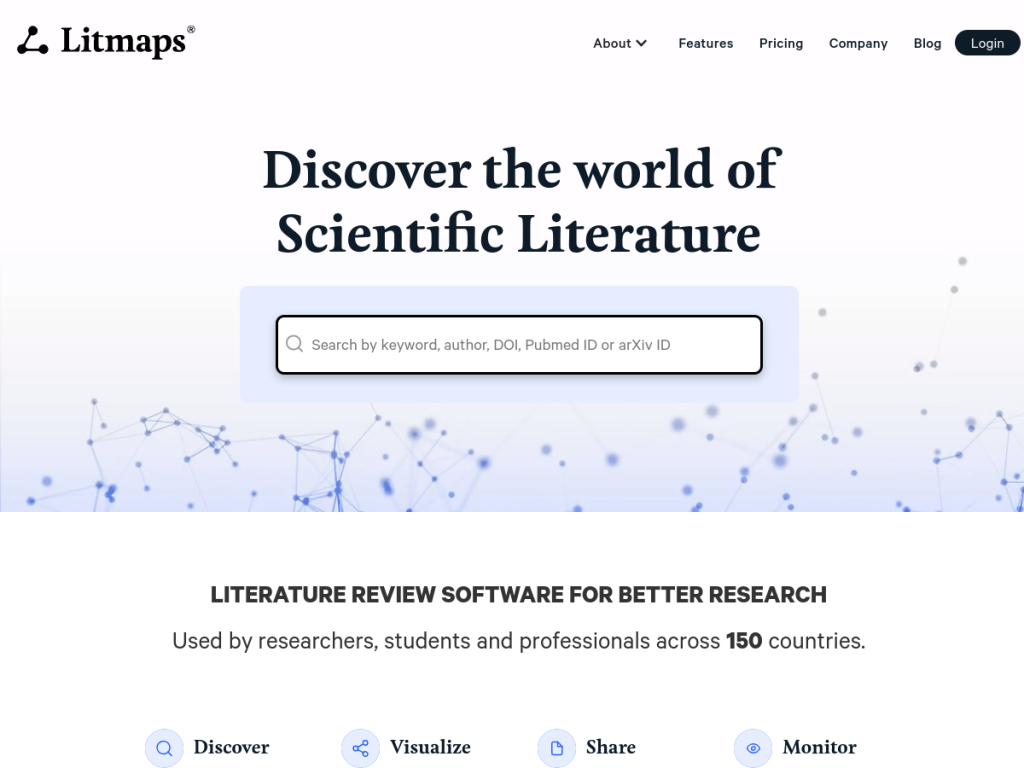
Litmaps is a literature review platform that helps researchers discover and visualize connections between academic papers, using AI-assisted discovery to map relationships between citations and identify relevant research faster. It offers four main capabilities: Discover (find relevant academic papers efficiently), Visualize (view research as a networked map rather than a list), Share (collaborate with colleagues and advisors), and Monitor (receive automatic updates on new publications in your field). Seeing a literature list as a network is designed to enhance the research thinking process and surface deeper results. Litmaps reports use by 350,000-plus researchers across 150 countries. It offers a free tier with limits and paid plans for more maps and features.
What it does well
- Visual maps: see how papers connect, not just a list.
- AI-assisted discovery: find relevant papers faster.
- Monitoring: automatic alerts on new publications.
- Collaboration: share maps with colleagues and advisors.
Who it is for
Litmaps fits researchers, graduate students, and academics doing literature reviews or exploring a new field, who want to discover relevant papers, understand how work connects, and monitor new publications — and who find a visual citation map more insightful than a flat reference list. Its sharing features suit research teams and advisor relationships. Those who only occasionally look up a paper may not need it, and AI-suggested papers should still be evaluated critically, but for mapping and keeping up with academic literature, Litmaps is a capable, free-to-start choice.
Things to keep in mind
- AI-suggested papers should still be evaluated critically for relevance.
- More maps and advanced features require paid plans.
- It complements, rather than replaces, careful reading of the literature.
Our verdict
Litmaps is a genuinely useful research companion, and its core idea — visualizing academic literature as a connected network rather than a flat list — makes discovering relevant papers, understanding a field, and spotting gaps much easier. AI-assisted discovery speeds the search, monitoring keeps you current, and sharing supports collaboration with colleagues and advisors. AI suggestions still need critical evaluation and richer features are paid, but for literature reviews and staying on top of a field, Litmaps is an excellent, free-to-start choice.
Frequently asked questions
What is Litmaps?
Litmaps is a research tool that maps connections between academic papers, visualizing literature as a network and using AI-assisted discovery to find relevant work.
How does Litmaps help research?
It lets you discover relevant papers, visualize how they connect, share maps with colleagues, and monitor new publications in your field.
Is Litmaps free?
Litmaps offers a free tier with limits and paid plans for more maps and features.
Who is Litmaps for?
It is for researchers, graduate students, and academics doing literature reviews or exploring a field who want a visual, AI-assisted way to navigate papers.
Top Litmaps alternatives
Other hand-reviewed SEO tools worth comparing against Litmaps.
Ahrefs AIPaid
Ahrefs AI is a paid AI marketing and seo tool for SEO specialists. Our review covers what it…
BrightEdgePaid
BrightEdge is a paid AI marketing and seo tool for SEO specialists. Our review covers what it does,…
ClearscopePaid
Clearscope is a paid AI marketing and seo tool for SEO specialists. Our review covers what it does,…
ConductorPaid
Conductor is a paid AI marketing and seo tool for SEO specialists. Our review covers what it does,…
ContentHarmonyPaid
ContentHarmony by Content Harmony is a paid AI marketing and seo tool for SEO specialists. Our review covers…
CopymaticPaid
Copymatic is a paid AI marketing and seo tool for writers and marketers. Our review covers what it…
Are you the maker of Litmaps?
Show visitors this review with the badge below. Copy the code into your site or press kit; it links straight back to this page.