Key takeaways
- Mate Translate is a cross-platform translation app and browser extension for fast, in-context translation in 100+ languages.
- It translates without switching apps, syncs history and saved phrases across devices, and adds pronunciation and phrasebooks.
- Reference features like word genders and synonyms suit language learners, with offline support on iOS.
- Best for individuals who want convenient everyday translation woven into their browser and devices.
What Mate Translate is
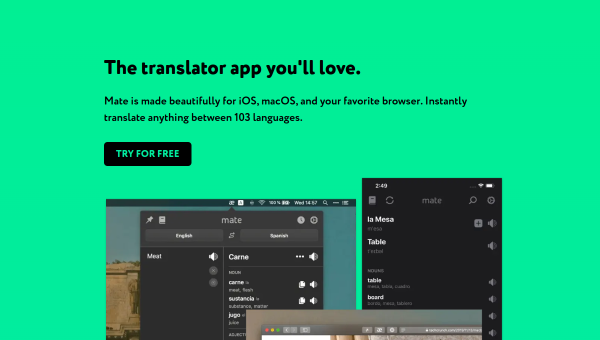
Mate Translate (branded simply as Mate) is a cross-platform translation application designed around convenience and staying in context. Available on iOS, macOS and as browser extensions, its core idea is translating without switching apps — highlight text on a webpage or in an app and translate it in place. It supports over a hundred languages and layers in features aimed at frequent translators and language learners: pronunciation with phonetics and audio, cross-device sync of history and saved phrases, and phrasebook functionality for organising and learning translations.
Its audience is individuals — professionals, travellers and language learners — who translate often and want it to be quick and integrated rather than a separate destination. Where enterprise platforms target localization at scale, Mate is a personal productivity tool focused on smooth, in-context everyday translation.
The AI features and experience
Mate uses machine translation across its 100+ languages, and its value is less about a unique engine and more about the experience wrapped around it: in-context translation via browser extensions, synchronised history and phrasebooks across devices, pronunciation guidance, and reference tools like word genders and synonyms that help learners. Offline capability on iOS makes it useful without a connection, and light/dark modes and a clean interface round out the polish.
The learner-friendly features — phonetics, phrasebooks, genders and synonyms — are a genuine differentiator for people using translation to study a language, not just to get a quick meaning. As with all machine translation, treat results for important content as approximate and verify anything consequential; Mate is built for convenient personal use rather than professional-grade accuracy, so it excels at everyday translation and learning rather than critical documents.
Strengths and limits
The strengths are convenience, cross-device integration and learner features. In-context translation without app-switching, synced history and phrasebooks, pronunciation and reference tools make Mate a smooth everyday companion, and offline iOS support helps travellers. For individuals, that integrated experience is the appeal.
The limits: it is a personal tool, not an enterprise localization platform, and its translation quality is general-purpose machine translation rather than best-in-class, so important content needs verification. It relies on subscription for full features. It is at its best as a convenient, learner-friendly everyday translator rather than a professional accuracy tool.
Who it suits
- Individuals who want quick, in-context translation in their browser and apps.
- Language learners who value pronunciation, phrasebooks and reference tools.
- Travellers who want synced, offline-capable translation across devices.
Verdict
Mate Translate is a polished, convenient cross-platform translation app that shines at in-context, everyday translation without switching apps, backed by cross-device sync, phrasebooks and learner-friendly reference features. For individuals, travellers and especially language learners, that integrated experience is genuinely useful. It is a personal tool rather than a professional localization platform, and its general-purpose translation needs verification for important content — but as a smooth, learner-oriented everyday translator, Mate is a likeable, practical choice.
Top Mate Translate alternatives
Other hand-reviewed Translation tools worth comparing against Mate Translate.
DeepLFreemium
DeepL is a freemium AI business and translation tool for writers and marketers. Our review covers what it…
Duolingo MaxFreemium
Duolingo Max is a freemium AI education and translation tool for students and educators. Our review covers what…
FluentCFreemium
FluentC is a freemium AI translation and writing assistant tool for writers and marketers. Our review covers what…
Google Translate AIFree
Google Translate AI is a free AI business and education tool for students and educators. Our review covers…
PhrasePaid
Phrase is a paid AI business and developer tool tool for business teams. Our review covers what it…
QuillBotFreemium
QuillBot is a freemium AI education and translation tool for writers and marketers. Our review covers what it…
Are you the maker of Mate Translate?
Show visitors this review with the badge below. Copy the code into your site or press kit; it links straight back to this page.