Key takeaways
- Winston AI is an AI-content detector offering sentence-level, colour-coded analysis of which passages may be AI-generated.
- It adds a plagiarism checker, grammar tools, essay grading, OCR for images, and many integrations (Chrome, WordPress, API).
- It supports 14+ languages and targets educators, SEO professionals, publishers and writers.
- Its headline accuracy figure is self-reported; as with all detectors, treat results as a signal, not proof.
What Winston AI is
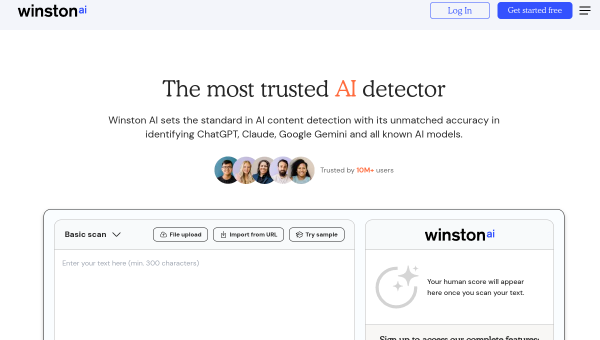
Winston AI is an AI-content detector that aims to be more granular than a single overall score. Its signature feature is sentence-level analysis: a colour-coded visualisation highlighting which specific passages the tool judges likely to be AI-generated, which is more actionable than a blunt document-wide percentage. Around detection it bundles a plagiarism checker, grammar checker, writing feedback, an essay grader, and OCR so you can scan text from images (.png, .jpg) as well as documents. It supports over a dozen languages and offers web, Chrome, WordPress, API and Zapier access.
Its audience spans education, SEO and publishing — anyone who wants to gauge whether content is human-written. The sentence-level view and OCR are practical touches: teachers can see where concerns lie within an essay, and publishers can check scanned or image-based text, not just pasted copy.
The AI features and their limits
Winston AI detects AI text across major models with sentence-level granularity, checks plagiarism, grades essays and offers writing feedback, all in multiple languages. It advertises a very high accuracy rate — a headline figure well above 99% — and provides quick results through its many access points. The sentence-level breakdown genuinely helps interpret results more thoughtfully than a single number.
That advertised accuracy, though, is self-reported, and here the standard warning is essential. Independent testing of AI detectors consistently finds false positives, bias against non-native English writers, weak performance on short texts, and susceptibility to paraphrasing and humanizer tools. A near-perfect accuracy claim should be read sceptically; real-world reliability is lower and context-dependent. The sentence-level view is helpful, but a highlighted passage is a prompt to look closer, not proof of cheating. High-stakes decisions must rest on a fair human process, not a Winston score alone.
Strengths and limits
The strengths are granularity and breadth. Sentence-level, colour-coded analysis is more useful than a lone percentage, and bundling plagiarism, grammar, essay grading, OCR and many integrations makes Winston a versatile package for educators and publishers. Multi-language support widens its usefulness.
The limits are the category’s, amplified by an especially high self-reported accuracy claim: false positives, bias, evasion and short-text weakness are all real, and no detector deserves blind trust. Treat Winston’s output — even at sentence level — as a signal to investigate within a fair process, never as a verdict.
Who it suits
- Educators who want sentence-level insight to inform integrity conversations.
- Publishers and SEO teams screening content, including scanned or image text via OCR.
- Writers who want detection plus plagiarism, grammar and feedback in one tool.
Verdict
Winston AI is a well-rounded AI-content detector whose sentence-level, colour-coded analysis and extras — plagiarism, grammar, essay grading, OCR, wide integrations — make it more useful and interpretable than a bare score. Its advertised near-perfect accuracy, though, is self-reported and should be treated with real scepticism: like every detector, it produces false positives, can be evaded, and struggles on short text. Use its results, even at sentence level, as a signal within a fair, human-led process — never as sole proof of AI authorship.
Top Winston AI alternatives
Other hand-reviewed Writing Assistants tools worth comparing against Winston AI.
AI21 LabsPaid
AI21 Labs is a paid AI marketing and writing assistant tool for writers and marketers. Our review covers…
AnywordPaid
Anyword is a paid AI marketing and writing assistant tool for writers and marketers. Our review covers what…
Article ForgePaid
Article Forge by Glimpse is a paid AI marketing and writing assistant tool for writers and marketers. Our…
BlogelyPaid
Blogely is a paid AI marketing and writing assistant tool for writers and marketers. Our review covers what…
BywordPaid
Byword is a paid AI marketing and writing assistant tool for writers and marketers. Our review covers what…
ChatGPTFreemium
ChatGPT by OpenAI is a freemium AI assistant and chatbot tool for writers and marketers. Our review covers…
Are you the maker of Winston AI?
Show visitors this review with the badge below. Copy the code into your site or press kit; it links straight back to this page.