Key Takeaways
- Wrike is an enterprise work management platform with AI woven throughout.
- Wrike Copilot answers questions and summarizes work; Wrike Agents automate tasks.
- AI Insights turn work data into actionable intelligence.
- Strong for cross-functional teams at scale; it is a robust enterprise tool.
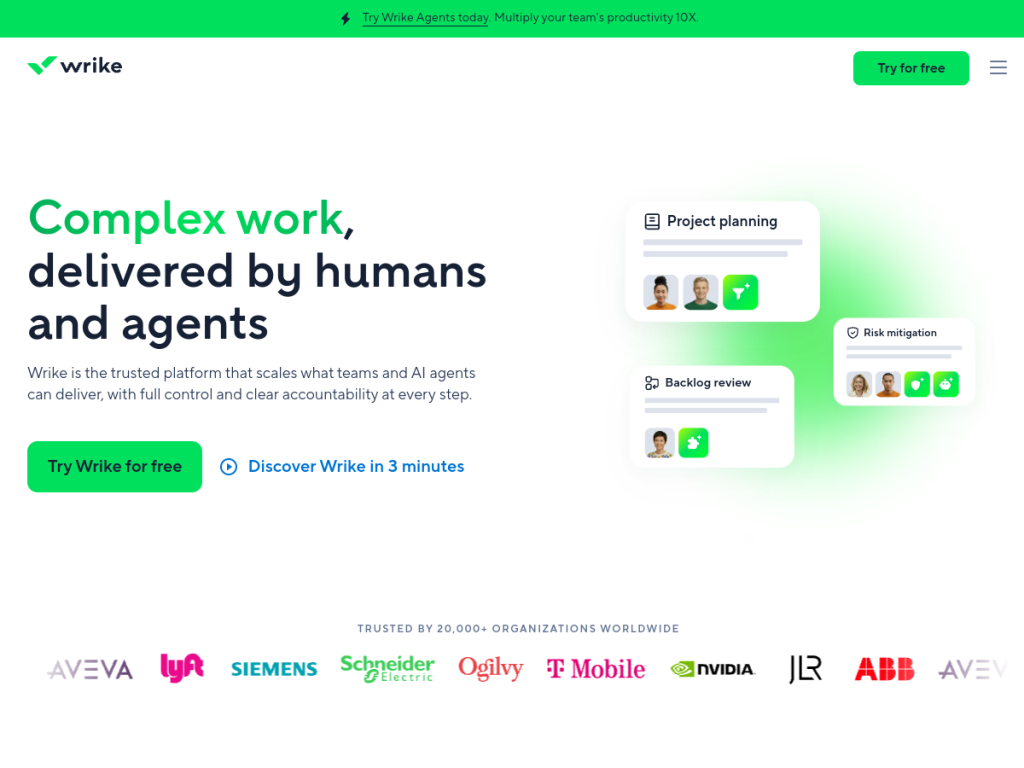
Wrike is an enterprise work management platform that helps teams plan, execute, and report on work with full visibility. It has embedded AI across the workflow — a copilot that answers questions and summarizes progress, agents that automate repeatable tasks, and analytics that turn raw work data into insight — so large, cross-functional teams can move faster and stay aligned.
What is Wrike?
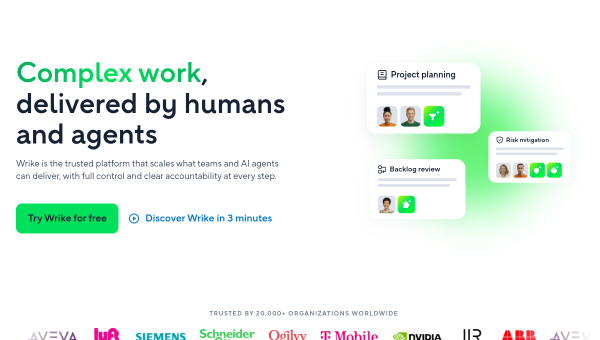
Wrike is an AI-powered work management platform used by tens of thousands of organizations to build, connect, and scale workflows with 360-degree visibility and collaboration. It spans the full workflow — ideate and align, plan and resource, execute, report and analyze, and learn and adapt — for teams in operations, marketing, product, professional services, PMO, and IT. Its AI features include Wrike Copilot, an embedded assistant that answers questions, summarizes work, and keeps teams moving; Wrike Agents, AI agents that deliver results on repeatable tasks; AI Insights that turn raw work data into clear, actionable intelligence; and an MCP server that connects Wrike to external AI assistants, plus a Work Intelligence Graph built from a huge base of historical data. Trusted by major enterprises, Wrike offers a free trial with per-user paid plans and enterprise options.
What it does well
- Full-lifecycle work management: planning through reporting and adapting.
- AI copilot and agents: answer questions, summarize, and automate tasks.
- AI insights: turn work data into actionable intelligence.
- Enterprise scale: visibility and collaboration across many teams.
Who it is for
Wrike fits mid-market and enterprise organizations with cross-functional teams that need robust work and project management with strong visibility and reporting — and now AI to summarize, automate, and surface insights. It suits operations, marketing, professional services, and PMO teams coordinating complex work. Small teams with simple needs may find lighter tools sufficient, but for organizations managing serious work at scale, Wrike is a capable, established platform with AI woven in.
Things to keep in mind
- Its depth and enterprise focus mean a learning curve and some setup.
- AI summaries, agents, and insights still benefit from human oversight.
- Costs scale per user, and advanced features sit on higher tiers.
Our verdict
Wrike is a strong enterprise work management platform, and its AI additions are practical: Copilot summarizes and answers, Agents automate repeatable work, and AI Insights turn a mass of work data into something teams can act on. For cross-functional organizations that need visibility, reporting, and collaboration at scale, it delivers — now with genuine AI acceleration. It has the depth (and learning curve) of an enterprise tool rather than a lightweight app, but for teams managing complex work, Wrike is a capable, AI-enhanced choice with a free trial to evaluate.
Frequently asked questions
What is Wrike?
Wrike is an enterprise work management platform for planning, executing, and reporting on work with full visibility, now with AI features like Copilot, Agents, and AI Insights.
What AI features does Wrike have?
Wrike offers Wrike Copilot (an AI assistant that answers and summarizes), Wrike Agents that automate repeatable tasks, AI Insights that turn work data into intelligence, and an MCP server for external AI.
Who is Wrike for?
It is for mid-market and enterprise organizations with cross-functional teams — operations, marketing, professional services, PMO, and IT — managing complex work at scale.
Is there a free trial of Wrike?
Yes. Wrike offers a free trial, with per-user paid plans that scale by features and enterprise options.