Key Takeaways
- BERT is a landmark open-source language model from Google Research.
- It transformed natural language processing when released in 2018.
- It reads text bidirectionally, understanding context from both sides.
- Still widely used and fine-tuned for NLP tasks; free and open-source.
BERT (Bidirectional Encoder Representations from Transformers) is one of the most important models in the history of natural language processing. Released by Google Research in 2018, it changed the field by reading text bidirectionally — understanding a word from the context on both sides of it — and by making powerful pretrained language understanding freely available to fine-tune. Though newer generative models get more attention today, BERT remains widely used, taught, and deployed, and it is free and open-source.
What is BERT?
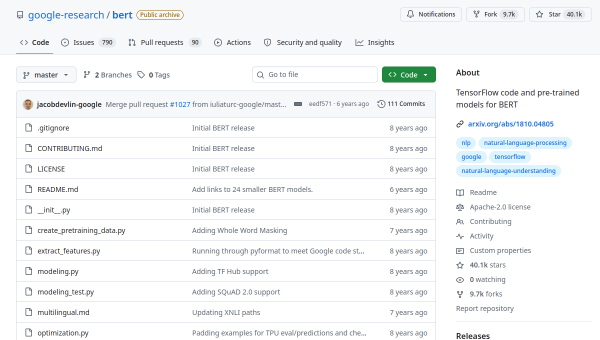
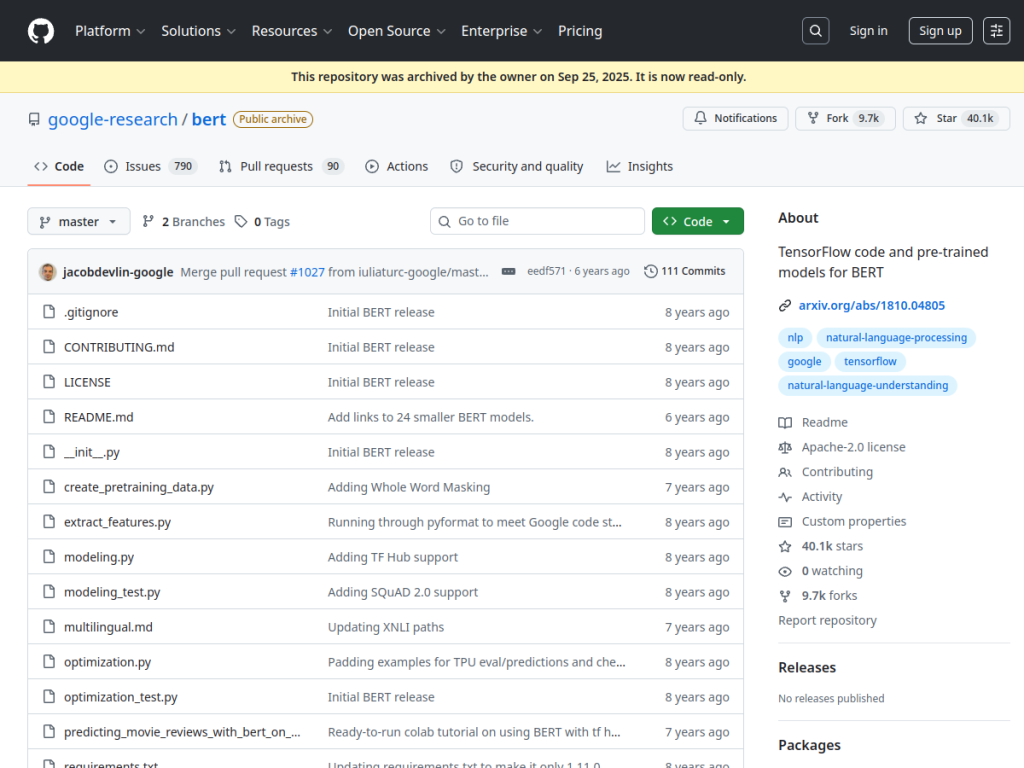
BERT (Bidirectional Encoder Representations from Transformers) is an open-source language model released by Google Research in 2018 that became a landmark in natural language processing. Its key innovation was deep bidirectional pretraining: unlike earlier models that read text left-to-right (or shallowly combined both directions), BERT is trained with masked language modeling, learning to predict hidden words using context from both sides, which produces much richer language understanding. Pretrained BERT models can be fine-tuned with relatively little data for many downstream tasks — classification, named-entity recognition, question answering, sentiment analysis, and more — often reaching strong results. It spawned a large family of variants (such as RoBERTa, DistilBERT, and ALBERT) and remains a staple in production NLP and research, and its ideas underpin much of what came after. Google has also used BERT-based understanding to improve Search. BERT is free and open-source (Apache 2.0), available on GitHub and through libraries like Hugging Face Transformers.
What it does well
- Landmark innovation: deep bidirectional language understanding.
- Fine-tunable: strong results on many NLP tasks with modest data.
- Free and open-source: widely available and well documented.
- Enduring: still used in production and taught widely.
Who it is for
BERT fits machine-learning engineers, NLP practitioners, researchers, and students who need solid language understanding for tasks like classification, entity recognition, sentiment analysis, and question answering — and who benefit from a free, well-understood, fine-tunable model that runs efficiently compared with large generative LLMs. It remains an excellent teaching model and a practical production choice for many focused NLP tasks. Those needing open-ended text generation or chat will use modern generative LLMs instead, and fine-tuning requires ML knowledge, but as a foundational, free NLP model, BERT is a landmark and still genuinely useful.
Things to keep in mind
- It is an encoder model for understanding, not open-ended text generation.
- Using it requires machine-learning knowledge and fine-tuning.
- Modern generative LLMs surpass it for chat and generation tasks.
Our verdict
BERT is a landmark in AI, and its influence is hard to overstate: by pretraining deep bidirectional language understanding, it reset expectations across natural language processing in 2018 and seeded a whole family of models. Practically, it remains genuinely useful — free, open-source, well documented, efficient, and fine-tunable with modest data for classification, entity recognition, question answering, and more. It is an understanding model rather than a generative chat model, and using it requires ML knowledge, but for focused NLP tasks and for learning how modern language models work, BERT is still excellent.
Frequently asked questions
What is BERT?
BERT (Bidirectional Encoder Representations from Transformers) is a landmark open-source language model from Google Research (2018) that reads text bidirectionally for deep language understanding.
What makes BERT important?
Its deep bidirectional pretraining (via masked language modeling) produced much richer language understanding and reset the state of the art across NLP, seeding models like RoBERTa and DistilBERT.
Is BERT free?
Yes, BERT is free and open-source (Apache 2.0), with pretrained models available on GitHub and through libraries like Hugging Face Transformers.
What is BERT used for?
It is fine-tuned for NLP tasks such as text classification, named-entity recognition, question answering, and sentiment analysis — understanding tasks rather than open-ended generation.
Top BERT alternatives
Other hand-reviewed Open Source tools worth comparing against BERT.
AgentGPTFreemium
AgentGPT by Reworkd is a freemium AI agents and automation tool for operations managers. Our review covers what…
Auto-GPTFree
Auto-GPT by Significant Gravitas is a free AI agents and automation tool for operations managers. Our review covers…
BabyAGIFree
BabyAGI by Yohei Nakajima is a free AI agents and automation tool for operations managers. Our review covers…
CrewAIFreemium
CrewAI is a freemium AI agents and automation tool for engineers. Our review covers what it does, pricing,…
Hugging FaceFreemium
Hugging Face is a freemium AI data analysis and developer tool tool for engineers. Our review covers what…
LangChainFreemium
LangChain is a freemium AI agents and automation tool for engineers. Our review covers what it does, pricing,…
Are you the maker of BERT?
Show visitors this review with the badge below. Copy the code into your site or press kit; it links straight back to this page.