Key takeaways
- ChatGPT is OpenAI’s conversational AI assistant — the tool that brought generative AI mainstream.
- It writes, edits, codes, analyses, summarises and answers questions, with voice, image understanding, web browsing and custom GPTs.
- A capable free tier plus paid plans (Plus/Pro/Team/Enterprise) that unlock the most advanced models and higher limits.
- Immensely useful, but it can hallucinate — verify facts, and avoid pasting confidential data.
What ChatGPT is
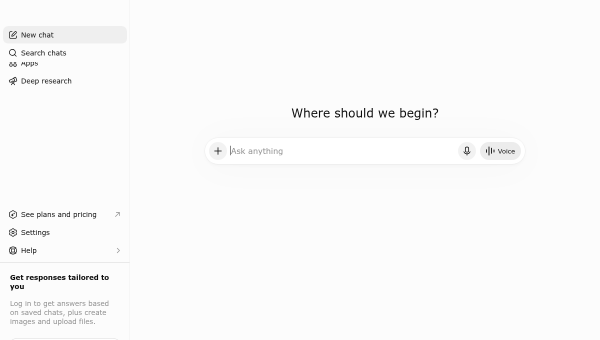
ChatGPT, from OpenAI, is the product that pushed generative AI into the mainstream and remains the most widely used AI assistant in the world. At its core it is a conversational interface to powerful large language models: you type (or speak) a request and it responds in natural language. But it has grown far beyond chat — today it writes and edits text, generates and debugs code, analyses documents and data, understands images, browses the web for current information, generates images, and lets users build and share custom versions (GPTs) tailored to specific tasks.
Its appeal is breadth and accessibility. Whether you are drafting an email, learning a concept, writing a script, brainstorming, or working through a coding problem, ChatGPT is a general-purpose assistant that handles an enormous range of tasks in one place. A genuinely useful free tier made it the entry point to AI for hundreds of millions of people.
The AI features
ChatGPT offers text generation and editing, coding help, document and data analysis, web browsing for up-to-date answers, image understanding and generation, voice conversations, and custom GPTs. Paid tiers — Plus, Pro, Team and Enterprise — unlock the most advanced OpenAI models, higher usage limits, and features like larger context and advanced reasoning. The ecosystem, including a large library of user-built GPTs and API access for developers, extends its reach well beyond the chat window.
For all its power, ChatGPT has real limitations that every user must keep in mind. It can “hallucinate” — produce confident, plausible-sounding information that is wrong — so factual claims, citations, code and calculations should be verified, not trusted blindly. Its knowledge has boundaries (mitigated but not eliminated by browsing), it can reflect biases in its training data, and conversations may be used to improve models unless you opt out, so you should avoid pasting confidential or sensitive information. It is a brilliant assistant, not an infallible oracle.
Strengths and limits
The strengths are versatility, quality and ecosystem. ChatGPT handles a vast range of tasks well, its top models are among the most capable available, and features like browsing, image tools, voice and custom GPTs make it a true multi-tool. The free tier and huge user base mean abundant community knowledge and integrations.
The limits are the category’s: hallucination and the need to verify, privacy considerations around what you share, potential bias, and the fact that the best capabilities sit behind paid tiers. Used critically — verifying important output and guarding sensitive data — it is transformative; used uncritically, its confident errors can mislead.
Who it suits
- Anyone wanting a versatile, general-purpose AI assistant for writing, coding and analysis.
- Professionals, students and creators who value breadth in one tool.
- Developers and power users who want advanced models, custom GPTs and API access.
Verdict
ChatGPT is the flagship AI assistant for good reason: extraordinary versatility, top-tier models, and a rich ecosystem of browsing, image, voice and custom-GPT features, accessible from a strong free tier. It is genuinely transformative for writing, coding, learning and analysis. The essential caveats are the category’s — it can hallucinate, so verify important output, and mind privacy with sensitive data. Used thoughtfully, ChatGPT is one of the most useful tools available today; it just should never be treated as an infallible source of truth.
Top ChatGPT alternatives
Other hand-reviewed Writing Assistants tools worth comparing against ChatGPT.
AI21 LabsPaid
AI21 Labs is a paid AI marketing and writing assistant tool for writers and marketers. Our review covers…
AnywordPaid
Anyword is a paid AI marketing and writing assistant tool for writers and marketers. Our review covers what…
Article ForgePaid
Article Forge by Glimpse is a paid AI marketing and writing assistant tool for writers and marketers. Our…
BlogelyPaid
Blogely is a paid AI marketing and writing assistant tool for writers and marketers. Our review covers what…
BywordPaid
Byword is a paid AI marketing and writing assistant tool for writers and marketers. Our review covers what…
ClaudeFreemium
Claude by Anthropic is a freemium AI assistant and chatbot tool for writers and marketers. Our review covers…
ChatGPT vs the competition
Are you the maker of ChatGPT?
Show visitors this review with the badge below. Copy the code into your site or press kit; it links straight back to this page.