Key takeaways
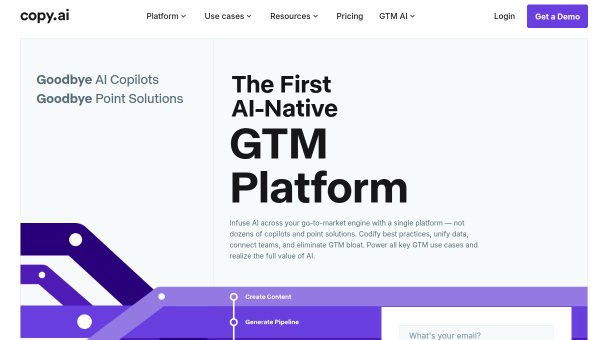
- Copy.ai has repositioned from a general AI copywriting tool into a go-to-market (GTM) AI platform for revenue teams.
- Its core is now Workflows, Actions, Agents and Tables — automating sales, marketing and operations processes, not just writing captions.
- It supports multiple LLMs (OpenAI, Anthropic, Google, Perplexity), brand voice and 2,000+ integrations (Salesforce, HubSpot, Gong).
- If you want a simple copywriting app, note the shift; if you want to automate GTM workflows, that is now its strength.
What Copy.ai is now
Copy.ai started life as one of the best-known AI copywriting tools — type a prompt, get marketing copy. It has since made a significant pivot: today it positions itself as a go-to-market (GTM) AI platform aimed at sales, marketing and operations teams. The emphasis has moved from generating individual pieces of copy to automating whole revenue processes. This matters when you evaluate it: if you remember Copy.ai as a caption generator, the product you will find is broader and more workflow-oriented than that.
The platform reports use across large enterprises and millions of users, and it is very much live and actively developed. But the framing has changed from “write my copy” to “run my go-to-market motions with AI.”
The AI features
Copy.ai’s current building blocks are Workflows (AI automations that codify a team’s processes), Actions (reusable steps non-technical users can chain together), Agents (AI that executes tasks with decision-making inside guardrails) and Tables (a unified data layer that consolidates sources). A Brand Voice feature keeps generated content on-tone, and the platform supports multiple large language models — OpenAI, Anthropic, Google Gemini and Perplexity — plus more than two thousand integrations with tools like Salesforce, HubSpot and Gong.
In practice that means using Copy.ai to automate things like prospecting, lead processing, deal coaching, content production and CRM enrichment, rather than one-off copy. The copywriting DNA is still there — content creation remains a use case — but it is now one workflow among many.
Strengths and limits
The strengths are automation breadth and integration depth. For a revenue team drowning in fragmented AI point-tools, consolidating prospecting, content and ops workflows on one platform — with brand voice and multi-LLM flexibility — is a real value proposition. The Tables data layer and 2,000+ integrations make it capable of touching the systems teams actually use.
The limits: the pivot means Copy.ai is now more platform than app. There is a learning curve to building workflows and agents, and it is aimed at teams, not a solo user who just wants quick copy — for that, simpler writing tools are a better fit. As with any AI automation, agents acting on your CRM or outreach need guardrails and human oversight, and generated content still needs editing before it ships.
Who it suits
- Sales, marketing and operations teams that want to automate GTM processes, not just write copy.
- Companies looking to consolidate several AI point-tools into one workflow platform.
- RevOps teams that value multi-LLM support and deep CRM integrations.
Verdict
Copy.ai is no longer best understood as a copywriting app — it has become a go-to-market AI platform for revenue teams, built on workflows, agents and a unified data layer. That makes it powerful for teams automating sales and marketing processes, and probably more than a solo writer needs. Evaluate it for what it is today: if GTM automation is your goal, Copy.ai is a serious, well-integrated option; if you just want quick marketing copy, a lighter writing tool will serve you better.