Key takeaways
- DeepL is a leading AI translator widely praised for producing more natural, nuanced translations than many rivals.
- It handles text and document translation across 100+ languages, with glossaries and rules to keep terminology consistent.
- DeepL Write improves and adapts your writing, and DeepL Voice offers real-time translation for meetings.
- Best for professionals and businesses who need high-quality translation; still review output for high-stakes content.
What DeepL is
DeepL is an AI-powered translation platform that built its reputation on quality. Where general machine translation can feel stiff or literal, DeepL is widely regarded as producing more natural, contextually accurate translations, particularly among European languages, which earned it a loyal following among professionals. It has since grown into a broader language platform covering text and document translation across more than a hundred languages, plus writing enhancement (DeepL Write) and real-time voice translation (DeepL Voice). It reports use by hundreds of thousands of businesses.
Its core appeal remains translation quality. For anyone who has been frustrated by clunky machine translation, DeepL often reads noticeably more fluently, which matters when the translated text represents your business, your research or your communication. Document translation that preserves formatting, and glossaries that enforce consistent terminology, make it practical for real work rather than just quick lookups.
The AI features
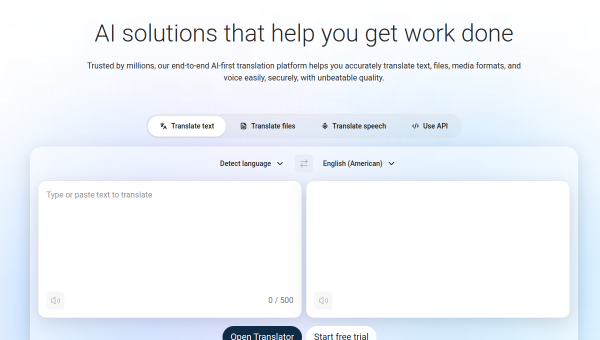
DeepL translates text and whole documents while preserving formatting, and lets you define glossaries and rules so key terms and brand language stay consistent across translations. DeepL Write goes beyond translation to enhance your writing — adjusting style and tone and adapting text to your audience — and DeepL Voice brings real-time translation to spoken conversations and meetings. An API lets developers embed DeepL’s translation into their own multilingual applications.
The translation quality and the glossary control are the standout features for professional use. That said, no machine translation is perfect: DeepL can still make errors, miss cultural nuance, or mistranslate ambiguous or highly specialised text. For high-stakes content — legal, medical, marketing that must land precisely — treat DeepL’s output as an excellent first draft that a human fluent in the target language should review, not a final publication-ready translation.
Strengths and limits
The strengths are translation quality, formatting preservation and terminology control. DeepL’s natural output, document handling and glossaries make it a genuinely professional tool, and the addition of Write and Voice extends it across written and spoken communication. Strong privacy and security options suit business use.
The limits: even the best machine translation needs human review for important content, and DeepL’s quality edge varies by language pair — it is strongest on major European languages and less consistently ahead elsewhere. Advanced features and higher volumes require DeepL Pro. It is a superb aid, not a replacement for professional human translators where accuracy is critical.
Who it suits
- Professionals and businesses needing high-quality text and document translation.
- Teams that must keep terminology and brand voice consistent via glossaries.
- Anyone wanting more natural translations than typical machine translation.
Verdict
DeepL is one of the best AI translation tools available, distinguished by the naturalness and accuracy of its output, especially across major European languages. With document translation, glossaries, the DeepL Write writing assistant and DeepL Voice, it is a genuinely professional language platform. No machine translation is flawless, so review its output for high-stakes content and remember its quality edge varies by language pair — but for fast, high-quality translation that reads well, DeepL sets the standard.
Top DeepL alternatives
Other hand-reviewed Translation tools worth comparing against DeepL.
Duolingo MaxFreemium
Duolingo Max is a freemium AI education and translation tool for students and educators. Our review covers what…
FluentCFreemium
FluentC is a freemium AI translation and writing assistant tool for writers and marketers. Our review covers what…
Google Translate AIFree
Google Translate AI is a free AI business and education tool for students and educators. Our review covers…
Mate TranslateFreemium
Mate Translate is a freemium AI translation and writing assistant tool for writers and marketers. Our review covers…
PhrasePaid
Phrase is a paid AI business and developer tool tool for business teams. Our review covers what it…
QuillBotFreemium
QuillBot is a freemium AI education and translation tool for writers and marketers. Our review covers what it…
DeepL vs the competition
Are you the maker of DeepL?
Show visitors this review with the badge below. Copy the code into your site or press kit; it links straight back to this page.