Key Takeaways
- Forcepoint is a cybersecurity company focused on data security.
- Its AI Mesh classifies sensitive data with business context.
- It governs AI usage — inspecting prompts and blocking shadow AI.
- Great for enterprises protecting data, including in the AI era.
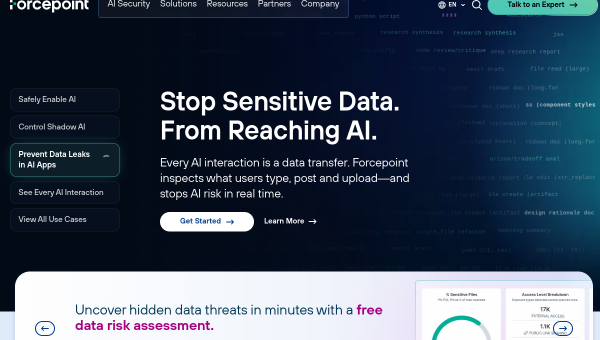
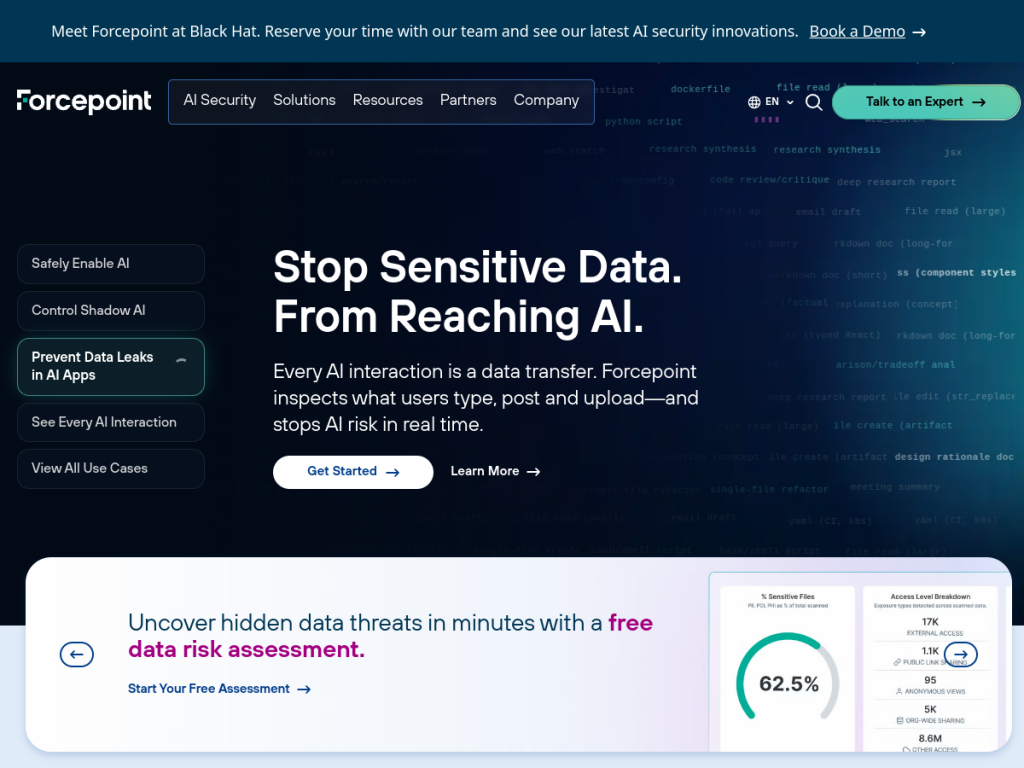
Forcepoint is an established cybersecurity company centered on data security — and it has adapted smartly to the AI era. Alongside data discovery, classification, and loss prevention, it now governs how employees use AI: inspecting prompts in real time, blocking shadow AI, and integrating with ChatGPT, Claude, and Microsoft Copilot. For enterprises worried about sensitive data leaking into AI tools, that focus is timely and genuinely useful.
What is Forcepoint?
Forcepoint is a cybersecurity company specializing in data protection and security. Its AI and data-security features include AI Mesh technology, which classifies sensitive data with business context for precise, reliable control and enables continuous discovery of shadow data and over-permissioned files; DSPM (Data Security Posture Management), which discovers and classifies data at scale across cloud environments and identifies redundant, obsolete, or trivial data; and DDR (Data Detection and Response), which monitors data continuously to detect potential breach activity and aims to prevent threats before they occur. Its AI-specific capabilities govern usage across LLMs, copilots, and private models, inspect prompts and user interactions with AI tools in real time, block shadow AI and unapproved applications, and offer native integrations with ChatGPT, Claude, and Microsoft Copilot. Its broader portfolio includes DLP, web security, cloud app security, and email security. It serves enterprises across healthcare, financial services, manufacturing, retail, and government, citing 12,000-plus customers including major global brands. Pricing is arranged with sales.
What it does well
- Data-first security: discovery, classification, and DLP.
- AI governance: inspect prompts and block shadow AI.
- AI Mesh: classifies data with business context.
- Integrated: works with ChatGPT, Claude, and Copilot.
Who it is for
Forcepoint fits enterprises — especially in regulated sectors like healthcare, financial services, and government — that need to discover, classify, and protect sensitive data, and increasingly to govern how employees use AI tools so confidential data does not leak into prompts. Its AI-governance focus is timely for organizations adopting copilots. Small businesses will find lighter security tools sufficient, and enterprise security takes implementation and tuning, but for enterprises protecting data in the AI era, Forcepoint is a capable, well-adapted choice.
Things to keep in mind
- It is an enterprise security platform priced via sales.
- Implementation and tuning take real effort and expertise.
- Prompt inspection must be balanced with employee privacy considerations.
Our verdict
Forcepoint is a capable enterprise data-security platform, and its adaptation to the AI era is well judged: alongside data discovery, classification (via AI Mesh with business context), posture management, and detection and response, it now governs AI usage directly — inspecting prompts in real time, blocking shadow AI, and integrating natively with ChatGPT, Claude, and Copilot. For enterprises worried about sensitive data leaking into AI tools, that is a genuinely current concern well addressed. It takes enterprise implementation effort and is priced via sales, but for data security in the AI era, Forcepoint is a strong choice.
Frequently asked questions
What is Forcepoint?
Forcepoint is a cybersecurity company focused on data security, offering data discovery and classification (AI Mesh), DSPM, data detection and response, DLP, and AI usage governance.
How does Forcepoint govern AI use?
It inspects prompts and user interactions with AI tools in real time, blocks shadow AI and unapproved apps, and integrates natively with ChatGPT, Claude, and Microsoft Copilot.
What is AI Mesh?
AI Mesh is Forcepoint’s technology that classifies sensitive data with business context for precise control, and continuously discovers shadow data and over-permissioned files.
Who is Forcepoint for?
It is for enterprises — especially in regulated sectors — that need to protect sensitive data and govern employee use of AI tools.
Top Forcepoint alternatives
Other hand-reviewed Productivity tools worth comparing against Forcepoint.
Abnormal SecurityPaid
Abnormal Security by Abnormal AI is a paid AI business and productivity tool for business teams. Our review…
Adobe Acrobat AIFreemium
Adobe Acrobat AI is a freemium AI business and ocr tool for document-heavy teams. Our review covers what…
AirtableFreemium
Airtable is a freemium AI business and productivity tool for knowledge workers. Our review covers what it does,…
AlmanacPaid
Almanac is a paid AI business and productivity tool for knowledge workers. Our review covers what it does,…
AsanaFreemium
Asana is a freemium AI business and productivity tool for knowledge workers. Our review covers what it does,…
Automation AnywherePaid
Automation Anywhere is a paid AI business and productivity tool for business teams. Our review covers what it…
Are you the maker of Forcepoint?
Show visitors this review with the badge below. Copy the code into your site or press kit; it links straight back to this page.