Key takeaways
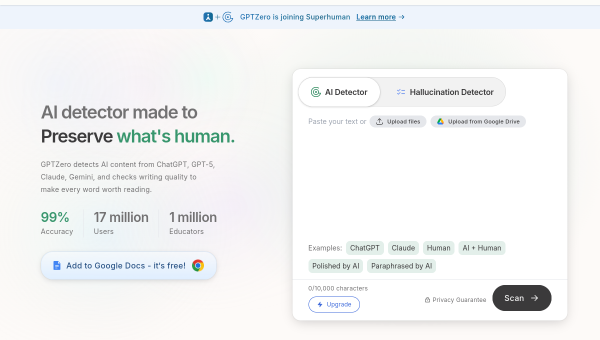
- GPTZero is a widely used AI-content detector that flags text likely written by models like ChatGPT, Claude and Gemini.
- It adds a hallucination detector, plagiarism checker, grammar tools and a writing report with editing-history replay.
- It states high accuracy but, to its credit, warns that no detector is 100% accurate and results should not be used to punish.
- Useful as one signal among many — never as sole proof of AI authorship, given real false-positive risk.
What GPTZero is
GPTZero is one of the earliest and best-known AI-content detectors, launched in early 2023 as ChatGPT use exploded in classrooms. It analyses text for statistical patterns associated with machine authorship and returns a likelihood that content was AI-generated. Around that core it has added a hallucination detector (to flag fabricated citations), a plagiarism checker, grammar tools, browser and Google Docs integrations, and a “writing report” that can replay a document’s editing history as verification. Its audience is educators, students, writers, recruiters and publishers concerned with authenticity.
Importantly, GPTZero is more candid than many competitors about limitations. It states plainly that no AI detector is 100% accurate, that accuracy varies with text length and language, that it has de-biased for non-native English writers, and — critically — that results “should not be used to punish or as the final verdict.” That honesty is the right framing for the entire category.
How AI detection actually works — and its limits
AI detectors like GPTZero estimate the probability that text was machine-written based on patterns such as predictability. But this is fundamentally probabilistic, not definitive. Independent research and widely reported incidents have shown that AI detectors produce false positives — flagging genuinely human writing, including that of non-native English speakers, as AI — and can be evaded by paraphrasing or “humanizer” tools. Accuracy is much lower on short texts.
This is why the responsible use GPTZero itself recommends matters so much. A detection score is a signal to prompt a conversation or closer look, never proof. Accusing a student or writer of cheating on a detector score alone is unfair and has led to real harm; the editing-history and writing-report features exist precisely to add context beyond a single number.
Strengths and limits
The strengths are breadth and honesty. GPTZero offers detection plus hallucination checking, plagiarism, grammar and verification tools, has a large user base, and is refreshingly upfront that its output is not a verdict. Its focus on longer English documents is where detection is most (though not perfectly) reliable.
The limits are inherent to AI detection, not GPTZero specifically: false positives, bias risk, evasion and weak performance on short text. The self-reported accuracy figures should be read with healthy scepticism, as independent results vary. Treat GPTZero as a helpful indicator within a fair, human-led process — not as an authority.
Who it suits
- Educators who want a signal to inform (not decide) academic-integrity conversations.
- Publishers and editors screening for likely AI content as one input.
- Writers who want to check their work and verify authorship with editing history.
Verdict
GPTZero is among the most capable and, notably, most honest AI-content detectors, pairing detection with hallucination, plagiarism and verification tools while openly warning that no detector is definitive. That candour is exactly right: AI detection is probabilistic and carries a real false-positive risk, so scores must be treated as one signal within a fair, human-led process — never as sole proof. Used that way, GPTZero is a useful tool; used as a verdict, any detector, including this one, can do real harm.
Top GPTZero alternatives
Other hand-reviewed Writing Assistants tools worth comparing against GPTZero.
AI21 LabsPaid
AI21 Labs is a paid AI marketing and writing assistant tool for writers and marketers. Our review covers…
AnywordPaid
Anyword is a paid AI marketing and writing assistant tool for writers and marketers. Our review covers what…
Article ForgePaid
Article Forge by Glimpse is a paid AI marketing and writing assistant tool for writers and marketers. Our…
BlogelyPaid
Blogely is a paid AI marketing and writing assistant tool for writers and marketers. Our review covers what…
BywordPaid
Byword is a paid AI marketing and writing assistant tool for writers and marketers. Our review covers what…
ChatGPTFreemium
ChatGPT by OpenAI is a freemium AI assistant and chatbot tool for writers and marketers. Our review covers…
Are you the maker of GPTZero?
Show visitors this review with the badge below. Copy the code into your site or press kit; it links straight back to this page.