Key takeaways
- OpenEvidence is a medical-knowledge platform for healthcare professionals, answering clinical questions grounded in peer-reviewed evidence.
- It draws on trusted sources — NEJM, JAMA, NCCN, Cochrane and others — with citations, and is HIPAA compliant.
- It is aimed at clinicians (with a free app), not patients, as a point-of-care evidence and decision-support aid.
- Answers are assistive and must be verified against sources and clinical judgement — not a substitute for it.
What OpenEvidence is
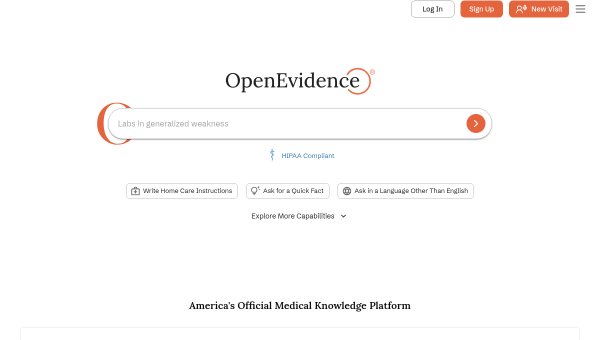
OpenEvidence is an AI-powered medical-knowledge platform built for healthcare professionals. Rather than a general chatbot, it answers clinical questions with responses grounded in peer-reviewed medical research, citing trusted sources such as the New England Journal of Medicine, JAMA, NCCN guidelines and Cochrane reviews. It is designed as a point-of-care tool — a way for clinicians to quickly get evidence-based answers to clinical questions, with the underlying sources attached — and is available as a free app, HIPAA compliant, and backed by significant healthcare and technology investors and journal partnerships.
The problem it addresses is real: medical knowledge is vast and changes constantly, and clinicians need fast, trustworthy answers grounded in current evidence, not the ungrounded output of a general AI. By tying its answers to peer-reviewed literature and named sources, OpenEvidence aims to be the medical counterpart to a cited answer engine — giving clinicians speed without sacrificing the ability to check the evidence behind a claim.
The AI features and caveats
OpenEvidence provides AI-generated answers to clinical questions, each grounded in and citing peer-reviewed research, with access to figures, tables and multimedia from partnered publications. Its partnerships with leading journals and guideline bodies distinguish it, and HIPAA compliance suits clinical use. The citation-first design is central: it lets clinicians verify the basis for any answer.
The caveats are essential even with strong grounding. AI can still misinterpret or misapply evidence, oversimplify nuance, or cite a source that does not fully support a claim — so clinicians must verify answers against the cited sources and apply their own clinical judgement to the specific patient. It is a decision-support and knowledge aid for professionals, not a substitute for clinical training, guidelines or individualised care, and it is explicitly for clinicians rather than patients seeking medical advice. Used as a fast, verifiable evidence lookup that a clinician then judges and applies, OpenEvidence is valuable; treated as an authority to follow unchecked, it is misused.
Strengths and limits
The strengths are evidence grounding, citations and clinician focus. Answers tied to peer-reviewed research from trusted journals, with sources attached, make OpenEvidence far more suitable for clinical use than a general chatbot, and its journal partnerships and HIPAA compliance add credibility. A free app lowers the barrier for clinicians.
The limits: AI can still misread or misapply evidence, so verification against sources and clinical judgement is required; it is a professional tool, not for patients self-diagnosing; and it supports, rather than replaces, guidelines and individualised care. Used as a verifiable aid under clinician judgement, it is strong.
Who it suits
- Clinicians who want fast, evidence-grounded answers with citations at the point of care.
- Healthcare professionals who value sources from NEJM, JAMA, NCCN and Cochrane.
- Clinicians who will verify answers against sources and apply their own judgement.
Verdict
OpenEvidence is a strong medical-knowledge platform for clinicians, answering clinical questions with responses grounded in and citing peer-reviewed research from trusted journals and guideline bodies — the medical counterpart to a cited answer engine. That evidence grounding, plus HIPAA compliance and a free app, makes it far more suitable for clinical use than a general chatbot. As with all AI, it can misread or misapply evidence, so clinicians must verify answers against sources and apply their own judgement; it is a professional aid, not for patient self-diagnosis. Used that way, it is a genuinely useful point-of-care tool.
Top OpenEvidence alternatives
Other hand-reviewed AI Health tools worth comparing against OpenEvidence.
AbridgeFree
Abridge is a free AI health tool. Our hands-on review covers features, pricing, pros and cons, and who…
CortiFreemium
Corti is a freemium AI health tool. Our hands-on review covers features, pricing, pros and cons, and who…
DeepScribePaid
DeepScribe is a paid AI health tool. Our hands-on review covers features, pricing, pros and cons, and who…
FreedFree
Freed is a free AI health tool. Our hands-on review covers features, pricing, pros and cons, and who…
Glass HealthFree Trial
Glass Health is a free trial AI health tool. Our hands-on review covers features, pricing, pros and cons,…
Hippocratic AIPaid
Hippocratic AI is a paid AI health tool. Our hands-on review covers features, pricing, pros and cons, and…
Are you the maker of OpenEvidence?
Show visitors this review with the badge below. Copy the code into your site or press kit; it links straight back to this page.