Key Takeaways
- scite shows how research papers have been cited — and how.
- Its “Smart Citations” flag supporting vs. contrasting citations.
- It helps researchers judge whether findings hold up.
- Great for evaluating the reliability of scientific claims.
scite tackles a subtle but crucial research problem: a paper being cited a lot does not mean its findings are supported — it might be cited because others disputed it. scite’s “Smart Citations” analyze not just how often a paper is cited but how: whether each citing work supports, contrasts, or merely mentions it. That context helps researchers judge whether a claim actually holds up, making scite a genuinely valuable tool for evaluating scientific reliability.
What is Scite?
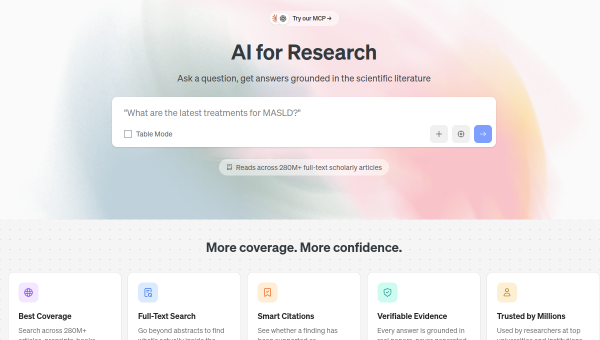
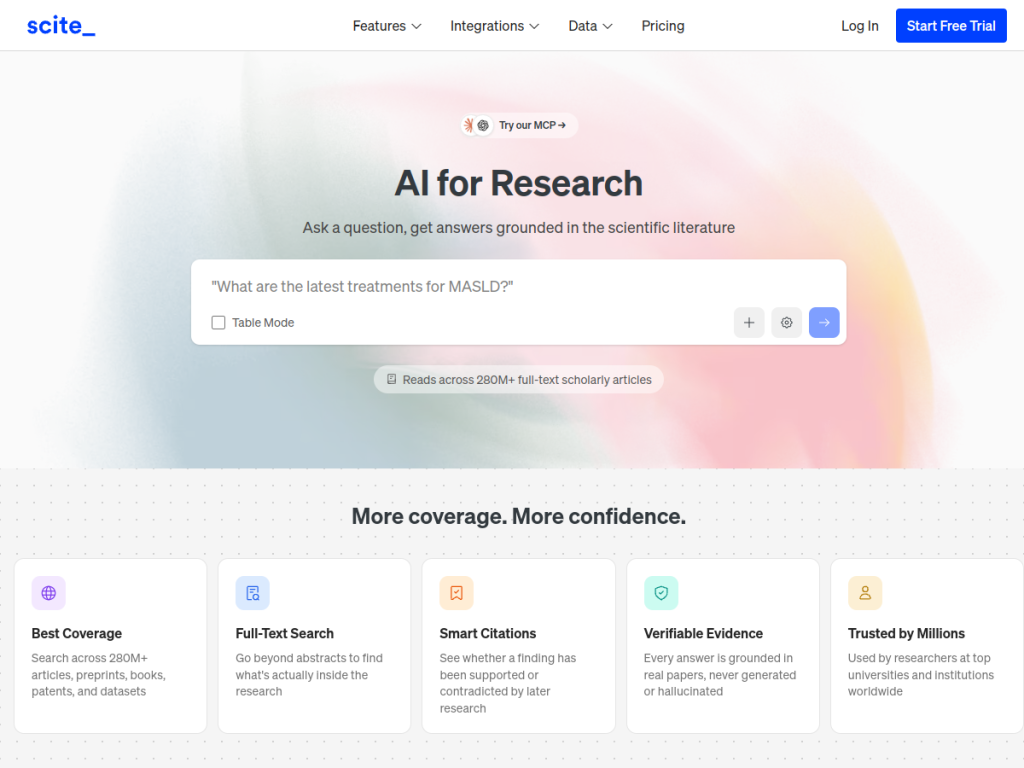
scite (scite.ai) is a research tool that helps users evaluate and understand scientific literature through “Smart Citations.” Rather than treating all citations equally, scite uses machine learning to analyze the context in which a paper is cited and classify each citation as supporting, contrasting (disputing), or merely mentioning the cited work. This lets researchers see not just how many times a paper has been cited, but how the scientific community has actually engaged with its findings — a far more meaningful signal of reliability than a raw citation count. Its features typically include Smart Citation data on papers, a citation-aware search and discovery interface, reference checking (seeing how the sources in a document have been supported or contested), custom dashboards for tracking literature, and an AI research assistant that answers questions grounded in the scientific literature with citations. It draws on a very large database of analyzed citations across published research. It targets researchers, academics, students, clinicians, librarians, and anyone evaluating scientific claims. scite offers some free access with a paid subscription for full features, plus institutional plans.
What it does well
- Smart Citations: supporting vs. contrasting, not just counts.
- Judge reliability: see how findings were actually received.
- Citation-aware search and reference checking.
- AI assistant: answers grounded in the literature.
Who it is for
scite fits researchers, academics, students, clinicians, and librarians who need to evaluate the reliability of scientific claims — seeing not just how often a paper is cited but whether citing works supported or disputed its findings, and checking whether a document’s references hold up. That context is genuinely valuable for serious literature work. Casual users wanting a simple search may not need it, full features require a subscription (institutions often provide access), and — as with any research AI — its assistant’s answers should be verified against the cited sources. For evaluating scientific reliability, scite is an excellent choice.
Things to keep in mind
- Full features require a subscription (institutions often provide access).
- The AI assistant’s answers should be verified against cited sources.
- Citation classifications are AI-generated and, while useful, not infallible.
Our verdict
scite is a genuinely valuable research tool that addresses a subtle but crucial problem: citation counts do not tell you whether a paper’s findings are actually supported — a heavily-cited paper might be cited because others disputed it. scite’s Smart Citations use machine learning to classify each citation as supporting, contrasting, or mentioning, so researchers can see how the scientific community really engaged with a paper’s claims. Add citation-aware search, reference checking, and an AI assistant grounded in the literature, and it becomes a powerful way to judge reliability. Full features are subscription-based and AI classifications aren’t infallible, but for evaluating scientific claims, scite is an excellent choice.
Frequently asked questions
What is scite?
scite (scite.ai) is a research tool that uses “Smart Citations” to show not just how often a paper is cited but whether citing works support, contrast, or merely mention its findings.
What are Smart Citations?
Smart Citations use machine learning to classify each citation by context — supporting, contrasting (disputing), or mentioning — giving a more meaningful signal of a paper’s reliability than a raw citation count.
Is scite free?
scite offers some free access, with a paid subscription for full features; institutional plans also provide access for many users.
Who is scite for?
It is for researchers, academics, students, clinicians, and librarians who need to evaluate the reliability of scientific claims and literature.
Top Scite alternatives
Other hand-reviewed SEO tools worth comparing against Scite.
Ahrefs AIPaid
Ahrefs AI is a paid AI marketing and seo tool for SEO specialists. Our review covers what it…
BrightEdgePaid
BrightEdge is a paid AI marketing and seo tool for SEO specialists. Our review covers what it does,…
ClearscopePaid
Clearscope is a paid AI marketing and seo tool for SEO specialists. Our review covers what it does,…
ConductorPaid
Conductor is a paid AI marketing and seo tool for SEO specialists. Our review covers what it does,…
ContentHarmonyPaid
ContentHarmony by Content Harmony is a paid AI marketing and seo tool for SEO specialists. Our review covers…
CopymaticPaid
Copymatic is a paid AI marketing and seo tool for writers and marketers. Our review covers what it…
Are you the maker of Scite?
Show visitors this review with the badge below. Copy the code into your site or press kit; it links straight back to this page.