Key takeaways
- SiteGPT builds an AI support chatbot trained on your own content — website pages, files, text and videos.
- It gives GPT-powered answers in your brand voice, syncs content automatically, captures leads and escalates to humans.
- Much simpler and cheaper to deploy than enterprise agent platforms; strong for SMBs and startups.
- Answer quality depends on your source content, so keep documentation clean and current.
What SiteGPT is
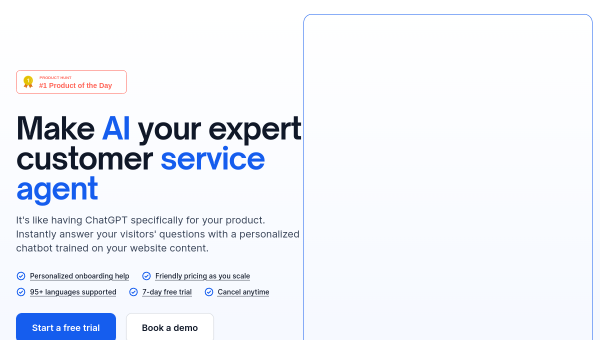
SiteGPT is an AI chatbot builder aimed at customer support, with a simple core idea: point it at your content and it becomes a support agent that answers questions about your business. You feed it URLs, files, text and even videos, and it trains a chatbot that responds using that material in your brand voice. It is designed for companies of all sizes that want automated support on their website, help center or in-app, without the heavy implementation of an enterprise platform.
That simplicity is SiteGPT’s appeal. Where enterprise agent platforms require significant setup, SiteGPT is closer to plug-and-play: connect your content, tune the chatbot, embed it. For a startup or small business, that is often exactly the right level of tool.
The AI features
SiteGPT trains a personalised chatbot on your custom content and generates GPT-powered responses that mirror your brand voice. It syncs content automatically on a schedule (daily, weekly or monthly) so answers stay current as your site changes, uses natural language to turn chat commands into in-app actions, and can escalate to a human agent when needed. It also captures leads from conversations and can send daily email summaries of chatbot interactions, plus integrations with tools like Zendesk and Slack. It advertises SOC 2, GDPR and HIPAA compliance, which matters for handling customer data.
The content-syncing and escalation features are the practical differentiators: automatic re-training keeps the bot accurate, and clean human escalation prevents the frustration of a bot that cannot help. As with any content-trained AI, the chatbot is only as good as the material it learns from — and it can still occasionally produce a confident wrong answer, so review and escalation paths matter.
Strengths and limits
The strengths are simplicity, speed to deploy and price. Training on your existing content means you can launch a capable support bot quickly, and features like auto-sync, lead capture and escalation cover the essentials small teams need. The compliance certifications make it viable for businesses handling sensitive data.
The limits: answer quality is bounded by your source content, so thin or outdated documentation produces a weak bot. It lacks the multi-agent orchestration and deep enterprise integrations of platforms like Kore.ai or Yellow.ai, which is fine for its audience but limiting for large, complex operations. And like all support AI, it needs monitoring and a reliable path to a human for questions it cannot answer.
Who it suits
- Startups and small businesses that want a website-trained support chatbot fast.
- Teams with solid documentation who want to automate common questions.
- Companies needing lead capture and human escalation without an enterprise build.
Verdict
SiteGPT is a practical, affordable way to put an AI support chatbot on your site by training it on your own content. Automatic content syncing, lead capture, human escalation and compliance certifications make it a strong fit for startups and small businesses that want results without an enterprise implementation. Keep your source content clean and current, monitor answers and maintain a clear path to a human, and SiteGPT can handle a large share of routine support questions with little ongoing effort.
Top SiteGPT alternatives
Other hand-reviewed AI Agents tools worth comparing against SiteGPT.
AgentGPTFreemium
AgentGPT by Reworkd is a freemium AI agents and automation tool for operations managers. Our review covers what…
Auto-GPTFree
Auto-GPT by Significant Gravitas is a free AI agents and automation tool for operations managers. Our review covers…
AutoGenFree
AutoGen by Microsoft is a free AI agents and automation tool for operations managers. Our review covers what…
BabyAGIFree
BabyAGI by Yohei Nakajima is a free AI agents and automation tool for operations managers. Our review covers…
BotsonicFreemium
Botsonic by Writesonic is a freemium AI agents and automation tool for operations managers. Our review covers what…
ChatbasePaid
Chatbase is a paid AI agents and automation tool for operations managers. Our review covers what it does,…
Are you the maker of SiteGPT?
Show visitors this review with the badge below. Copy the code into your site or press kit; it links straight back to this page.