Key Takeaways
- Stable Diffusion is the open-source image model you can run yourself — free and unlimited.
- Its strength is total control and privacy, with a huge ecosystem of community models and tools.
- Best for technical users and heavy creators who want no limits and full customisation.
- The trade-off is setup and a learning curve that hosted tools don’t ask of you.
Overview
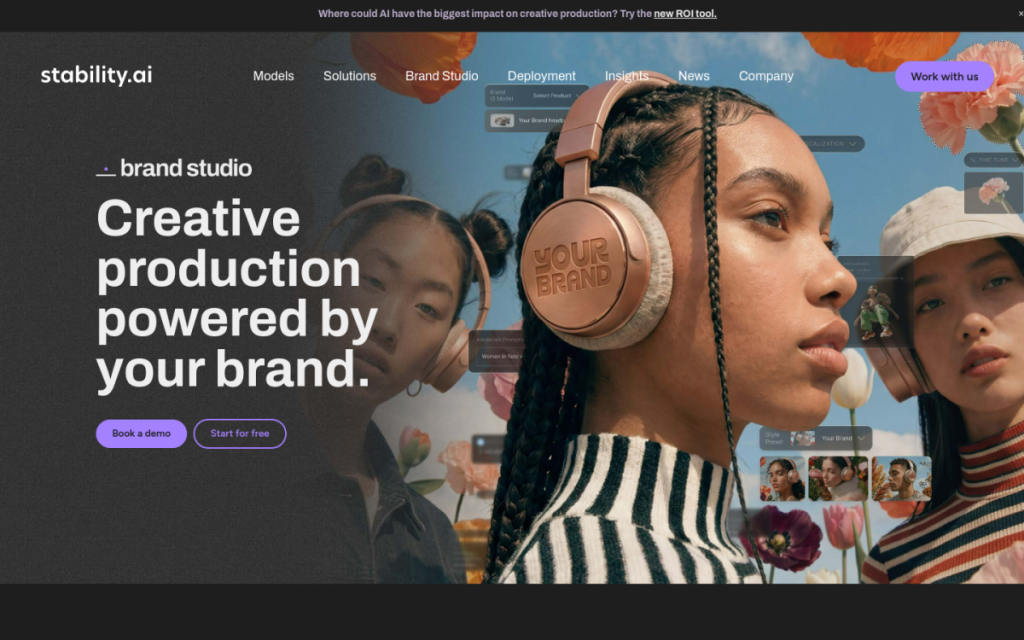
Stable Diffusion is the open-source foundation much of the AI image world is built on. Because the model is freely available, you can run it on your own computer for unlimited, completely private generation — and tap an enormous community of custom models, styles, and add-on tools. It’s the opposite of a polished hosted app: more power and freedom, in exchange for doing some of the technical work yourself.
Who should use it
- Technical creators who want unlimited, free, private generation.
- Heavy users who’d otherwise hit the credit limits of hosted tools.
- Tinkerers who want to train custom styles and use community models.
Key features
- Runs locally for unlimited, private, free generation.
- Open-source with a vast library of community models and styles.
- Fine control via tools that guide composition and consistency.
- No subscription — you own the whole pipeline.
Pricing
The model itself is free. Running it locally costs you nothing beyond a capable graphics card and some setup time. There are also paid hosted services that run Stable Diffusion for you if you’d rather skip the technical side, priced by usage.
Pros and cons
What we liked: unlimited free generation, total privacy, and unmatched customisation through the community ecosystem. For heavy or specialised work, nothing else compares on cost and control.
What we didn’t: the setup and learning curve are real, you need a decent GPU, and getting great results takes more effort than a polished hosted app.
How to use it well
- Start with a friendly interface that packages the setup for you.
- Explore community models for specific styles instead of the base model.
- Learn one control tool for consistency before going deep.
- Use a hosted version first if you want to try it without setup.
Alternatives
Midjourney and DALL·E 3 are far easier but paid and limited; Leonardo AI offers control with less setup; Bing Image Creator is the simplest free start. Stable Diffusion’s niche is unlimited, private, fully customisable generation.
We tested this: our hands-on experience
We approached Stable Diffusion as the power-user option it is — running it through a friendly interface rather than a bare command line — to weigh its freedom against its friction. The freedom is real and, once you’re set up, addictive: unlimited generations at no per-image cost, complete privacy since nothing leaves your machine, and access to a staggering library of community models, each tuned for a particular style. For the volume of images we generated in testing, that “no meter running” feeling changed how freely we experimented.
The friction is equally real. Getting a capable setup running took effort and a decent graphics card, and coaxing great results out of the base model took more prompt craft and tweaking than a polished hosted app demands. This is the trade at the heart of Stable Diffusion: you exchange convenience for control and cost-freedom. For a casual user who wants one nice image, that trade makes no sense. For someone generating at scale or chasing a very specific look, it’s transformative.
A real workflow example
Our most rewarding session involved a specific art style that hosted tools kept refusing to nail. On Stable Diffusion, we found a community model trained for exactly that aesthetic, loaded it, and suddenly the results snapped into the look we’d been chasing for an hour elsewhere. From there, unlimited generations meant we could explore dozens of variations without watching a credit counter, then use a control tool to keep composition consistent across the set. The combination of a specialised model and no usage limit produced work we simply couldn’t have gotten from a general hosted generator.
The lesson: Stable Diffusion is the choice for heavy users, tinkerers, and anyone needing a specific style, private generation, or unlimited output — provided you’re willing to handle some setup. Start with a packaged interface, explore community models for the look you want, and learn one control tool for consistency. If you just want a great image with zero effort, a hosted tool wins; if you want total control and freedom, nothing else compares.
Frequently asked questions
Is Stable Diffusion really free?
Yes — the model is open-source and free to run on your own hardware, with no generation limits. Paid hosted services exist if you’d rather not set it up yourself.
Do I need a powerful computer?
To run it locally, yes — a capable graphics card makes a big difference. If your hardware isn’t up to it, a hosted Stable Diffusion service is the easier route.
Final verdict
Stable Diffusion is the power user’s choice: free, unlimited, private, and endlessly customisable. If you generate a lot of images, want full control, or love to tinker, nothing else offers this much freedom. If you just want a great image with zero setup, a hosted tool will serve you better. Match it to your appetite for control, and it’s one of the most powerful creative tools in existence — for the price of your own electricity.
Sources: hands-on use of Stable Diffusion via local and hosted setups, checked against its official and community documentation at the time of writing.
Top Stable Diffusion alternatives
Other hand-reviewed Open Source tools worth comparing against Stable Diffusion.
AgentGPTFreemium
AgentGPT by Reworkd is a freemium AI agents and automation tool for operations managers. Our review covers what…
Auto-GPTFree
Auto-GPT by Significant Gravitas is a free AI agents and automation tool for operations managers. Our review covers…
BabyAGIFree
BabyAGI by Yohei Nakajima is a free AI agents and automation tool for operations managers. Our review covers…
BERTFree
BERT by Google Research is a free AI developer tool and open source tool for engineers. Our review…
CrewAIFreemium
CrewAI is a freemium AI agents and automation tool for engineers. Our review covers what it does, pricing,…
Hugging FaceFreemium
Hugging Face is a freemium AI data analysis and developer tool tool for engineers. Our review covers what…
Stable Diffusion vs the competition
Are you the maker of Stable Diffusion?
Show visitors this review with the badge below. Copy the code into your site or press kit; it links straight back to this page.