Key takeaways
- Tempus is an AI-powered precision-medicine company built on one of the largest libraries of clinical and molecular data.
- It offers genomic testing and AI insights across oncology, cardiology, neurology and more to personalise care.
- It works with clinicians, patients and life-sciences companies, and is advancing AI models (e.g. ECG-based prediction).
- AI insights inform clinical and research decisions but are assistive — physician judgement and validation remain essential.
What Tempus is
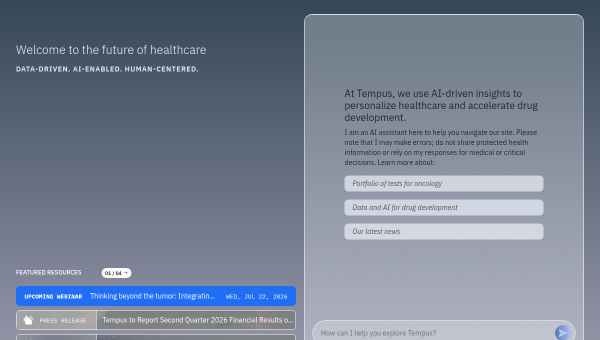
Tempus is an AI-driven precision-medicine company whose foundation is data: it has built one of the world’s largest libraries of clinical and molecular data, and an operating system to make that data usable, starting with cancer. In practice it provides genomic and molecular testing (for example, sequencing a tumour) and layers AI-driven analysis on top to help personalise treatment — matching patients to therapies and trials based on the molecular profile of their disease. It spans oncology, cardiology, neurology, pathology and more, serving clinicians, patients and life-sciences companies.
The promise of precision medicine is real and significant: treatments tailored to the specific biology of a patient’s disease rather than one-size-fits-all. Tempus contributes to this by combining large-scale data, testing and AI, and it is also active in research — developing AI models such as ECG-based prediction of conditions like atrial fibrillation and running programmes to integrate AI with the research community. Its scale and data assets are its defining strengths.
The AI features and caveats
Tempus uses AI to analyse clinical and molecular data at scale — informing treatment decisions, matching patients to therapies and trials, and powering diagnostic and predictive models across specialties. Its vast, structured data library is what makes this possible, and it partners with life-sciences companies to accelerate drug development and research.
The caveats are those of any AI in medicine, and they matter deeply here. AI-derived insights — therapy matches, risk predictions, molecular interpretations — are assistive inputs to clinical and research decisions, not verdicts. Physicians must apply their judgement, and predictive and diagnostic models require rigorous validation and appropriate regulatory clearance for their intended use. Genomic and health data are exceptionally sensitive, so privacy and consent are paramount. Tempus advances precision medicine meaningfully, but its AI supports expert decision-making rather than replacing it, and its outputs must be interpreted by qualified clinicians within validated, regulated frameworks.
Strengths and limits
The strengths are data scale, breadth and research depth. One of the largest clinical-molecular data libraries, combined with testing and AI across many specialties and active research, positions Tempus as a serious force in precision medicine, with real potential to personalise care and accelerate drug development.
The limits: it operates in a complex, highly regulated domain where AI insights are assistive and require physician judgement and validation; genomic data raises significant privacy responsibilities; and it is an enterprise/clinical platform, not a consumer tool. Its impact depends on rigorous, regulated, clinician-led use of its data and AI.
Who it suits
- Oncologists and clinicians using genomic testing to personalise treatment.
- Patients (via their providers) who may benefit from molecular-profile-guided care.
- Life-sciences companies leveraging large clinical-molecular data for research.
Verdict
Tempus is a major AI-driven precision-medicine company built on one of the largest clinical and molecular data libraries, combining genomic testing with AI to help personalise care — starting with cancer and extending across specialties — and to accelerate research. Its scale and data assets give it real potential to advance tailored medicine. As with all clinical AI, its insights are assistive inputs requiring physician judgement, validation and regulatory rigour, and its genomic data demands strong privacy protection. Within those bounds, Tempus is a significant, serious platform for precision medicine and research.
Top Tempus alternatives
Other hand-reviewed Healthcare tools worth comparing against Tempus.
Ada HealthFree
Ada Health is a free AI education and healthcare tool for healthcare providers. Our review covers what it…
AidocPaid
Aidoc is a paid AI healthcare and research tool for healthcare providers. Our review covers what it does,…
Buoy HealthFree
Buoy Health is a free AI education and healthcare tool for healthcare providers. Our review covers what it…
MerativePaid
Merative is a paid AI healthcare and research tool for healthcare providers. Our review covers what it does,…
Paige AIPaid
Paige AI is a paid AI healthcare and research tool for healthcare providers. Our review covers what it…
PathAIEnterprise
PathAI is an enterprise AI data analysis and healthcare tool for healthcare providers. Our review covers what it…
Are you the maker of Tempus?
Show visitors this review with the badge below. Copy the code into your site or press kit; it links straight back to this page.