Key Takeaways
- Webflow is a visual web platform to design, build, and host sites without code.
- AI now helps generate sites and sections, produce copy, and optimize content.
- It also targets AI search visibility (AEO), not just traditional SEO.
- Great for designers and teams building custom sites; it has a learning curve.
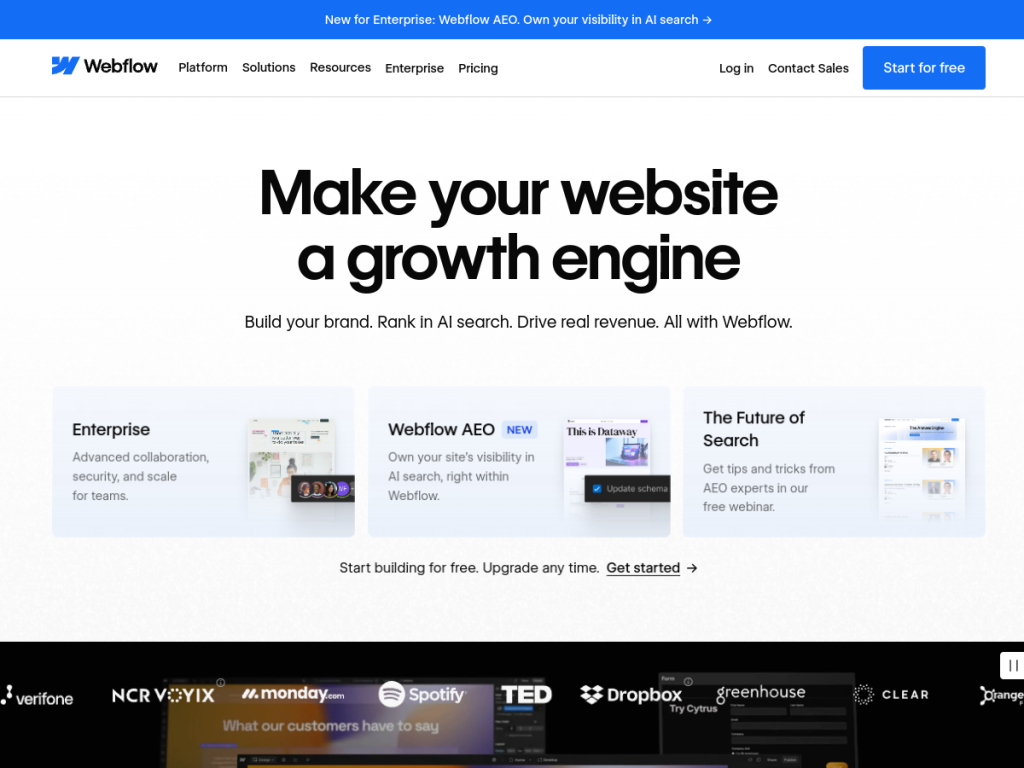
Webflow lets you design and build professional, custom websites visually — without writing code — while still producing clean, production-grade output. It has evolved into what it calls an agentic web platform, adding AI that can generate whole sites and sections, write and manage content, and optimize pages for both traditional and AI-driven search, so teams can build and grow sites faster.
What is Webflow?
Webflow is a visual web platform that combines design tools, a CMS, hosting, and analytics so teams can design, build, publish, and optimize websites without hand-coding. Its AI capabilities span three areas. Build: generate complete sites, page sections, and code components that automatically inherit your existing design system. Manage: produce copy and CMS content individually or in bulk, with AI handling content updates and SEO maintenance. Optimize: run experiments, personalize by audience, and optimize for both traditional search and AI-driven search (answer engine optimization, or AEO) — the newer discipline of showing up in AI answers. Webflow serves designers, marketers, developers, agencies, and enterprises, with a large user base including major brands, and offers a free plan plus paid site, workspace, and enterprise tiers.
What it does well
- Visual, code-free building: design custom sites that output clean code.
- AI build: generate sites and sections that follow your design system.
- AI content: create and manage copy and CMS content, individually or in bulk.
- AI-search optimization: tools for both SEO and answer-engine visibility.
Who it is for
Webflow fits designers, marketing teams, agencies, and businesses that want to build professional, custom websites without relying entirely on developers — and now to use AI to speed up building, content, and optimization. It is especially strong for design-led sites where control matters. Beginners wanting the simplest drag-and-drop builder may find a learning curve, and very simple sites may not need its power, but for custom, professional web building with a growing AI toolkit, Webflow is a leading choice with a free plan to start.
Things to keep in mind
- It is more powerful (and has a steeper learning curve) than basic site builders.
- AI-generated content and layouts still benefit from a human review.
- Costs scale with sites, workspaces, and enterprise features.
Our verdict
Webflow remains a top choice for building professional, custom websites visually, and its move into AI is substantive rather than superficial: generating sites and sections that respect your design system, managing content in bulk, and optimizing for AI-driven search all address real work. There is a learning curve compared with basic builders, and AI output wants a review, but for designers, agencies, and teams that want control and quality plus AI acceleration, Webflow is an excellent, free-to-start platform.
Frequently asked questions
What is Webflow?
Webflow is a visual web platform to design, build, host, and optimize custom websites without code, now with AI that generates sites, writes content, and optimizes for search.
What AI features does Webflow have?
It can generate sites and sections that follow your design system, produce and manage copy and CMS content in bulk, and optimize for both traditional and AI-driven search (AEO).
Is Webflow free?
Yes, Webflow has a free plan to build and learn, with paid site, workspace, and enterprise plans that scale by needs.
Is Webflow good for beginners?
It is more powerful than basic site builders and has a learning curve, but it rewards that with professional, custom control, plus AI to speed things up.
Top Webflow alternatives
Other hand-reviewed No-Code tools worth comparing against Webflow.
10WebPaid
10Web is a paid AI no code and website builder tool for founders and small businesses. Our review…
AdaloPaid
Adalo is a paid AI no code and website builder tool for non-technical builders. Our review covers what…
Bravo StudioFreemium
Bravo Studio is a freemium AI no code and website builder tool for non-technical builders. Our review covers…
BubbleFreemium
Bubble is a freemium AI business and no code tool for non-technical builders. Our review covers what it…
FlutterFlowPaid
FlutterFlow is a paid AI no code and website builder tool for founders and small businesses. Our review…
Framer AIFreemium
Framer AI is a freemium AI business and design tool for founders and small businesses. Our review covers…
Webflow vs the competition
Are you the maker of Webflow?
Show visitors this review with the badge below. Copy the code into your site or press kit; it links straight back to this page.