Key Takeaways
- WriteHuman rewrites AI-generated text to read more naturally and human.
- It targets telltale AI patterns like template phrasing and uniform cadence.
- It also includes an AI detector and an AI image detector, plus an API.
- Useful for polishing AI drafts; use it honestly, and mind that AI detection is imperfect.
WriteHuman is an AI humanizer: it takes text written by tools like ChatGPT, Claude, or Gemini and rewrites it to sound more natural and less machine-made. It focuses on the specific patterns that make AI writing feel robotic — generic phrasing, predictable rhythm, uniform sentence length — and smooths them out. It is a popular tool in a space that calls for honest, thoughtful use.
What is WriteHuman?
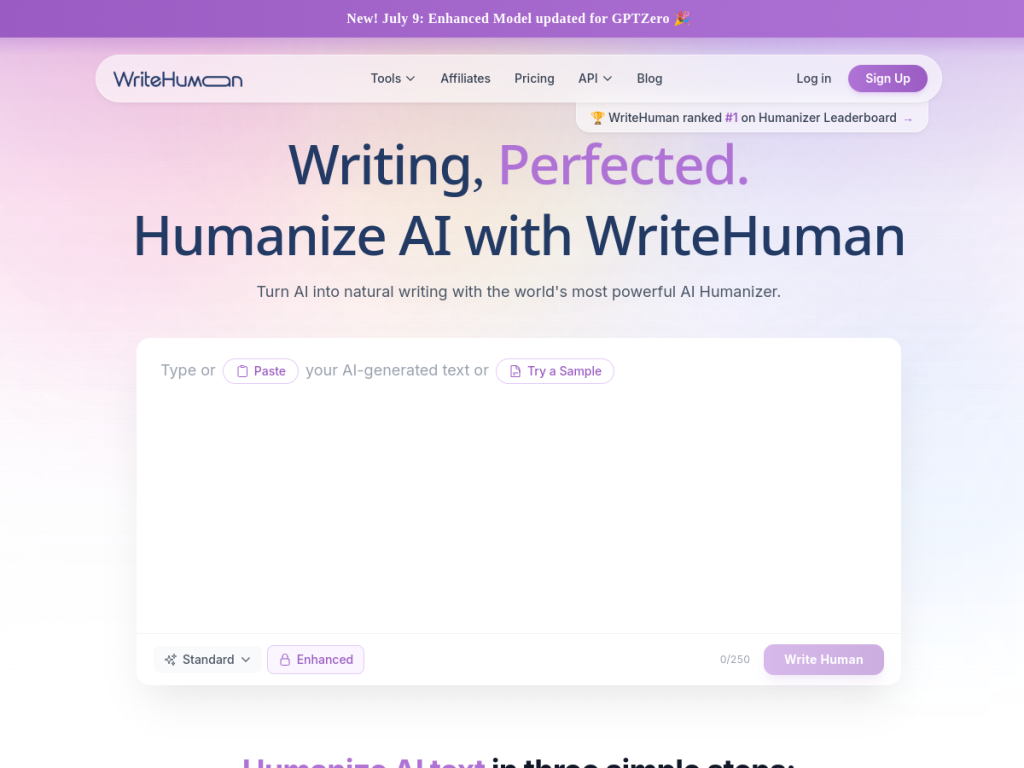
WriteHuman is a web platform that converts AI-generated text into more natural, human-sounding writing. Its humanizer targets four specific patterns: template phrasing (removing generic phrases), predictable cadence (varying sentence rhythm), uniform sentence length (mixing short and long sentences), and mechanical transitions (using conversational connectors instead of stiff formal ones). Alongside the humanizer it offers an AI detector to check whether text reads as AI-generated, an AI image detector, a word counter, and a developer API for integration. It keeps its model updated against detectors. WriteHuman displays clear pricing, with a free version to try and paid monthly plans (Basic, Pro, Ultra) that raise request and word limits, plus annual savings.
What it does well
- Targeted humanizing: fixes specific AI tells like cadence and phrasing.
- Extra tools: an AI detector, image detector, and word counter.
- Developer API: integrate humanizing into your own workflow.
- Clear, tiered pricing with a free version to try.
Who it is for
WriteHuman appeals to writers, students, and content creators who want AI-assisted drafts to read more naturally and in their own voice, or to check how text reads before submitting. Used to genuinely improve real writing, it can help. However, like all “humanizer” tools, it sits in ethically sensitive territory: using it to disguise AI work and deceive teachers, publishers, or readers breaches many academic and workplace rules, and AI detection industry-wide is unreliable. It should be used honestly, to improve your own work rather than to cheat.
Things to keep in mind
- Using humanizers to pass off AI work dishonestly can breach academic or workplace rules.
- AI content detection is unreliable across the industry, so treat results as guidance.
- Higher request and word limits require paid plans.
Our verdict
WriteHuman is a focused, clearly priced AI humanizer that does its narrow job well: smoothing the specific patterns — generic phrasing, uniform cadence, stiff transitions — that make AI text feel robotic, with an AI detector and API alongside. For legitimately polishing AI-assisted drafts into a more natural, human voice, it can be genuinely useful. But it lives in ethically sensitive territory, and using it to deceive breaches many rules while relying on inherently unreliable detection. Used honestly to improve real writing, WriteHuman is a capable tool with a free version to try; used to cheat, it invites trouble.
Frequently asked questions
What is WriteHuman?
WriteHuman is an AI humanizer that rewrites AI-generated text to sound more natural, targeting patterns like template phrasing and uniform cadence, with an AI detector and API alongside.
How does WriteHuman work?
Its humanizer targets four AI tells — template phrasing, predictable cadence, uniform sentence length, and mechanical transitions — rewriting text to read more naturally.
Is WriteHuman free?
There is a free version to try, with paid monthly plans around $12 (Basic), $18 (Pro), and $36 (Ultra), plus annual savings and an API.
Is it ethical to use an AI humanizer?
It depends on how you use it. Improving your own writing is fine; using it to disguise AI work and deceive teachers, publishers, or readers breaches many academic and workplace rules, and AI detection is unreliable regardless.
Top WriteHuman alternatives
Other hand-reviewed Writing Assistants tools worth comparing against WriteHuman.
AI21 LabsPaid
AI21 Labs is a paid AI marketing and writing assistant tool for writers and marketers. Our review covers…
AnywordPaid
Anyword is a paid AI marketing and writing assistant tool for writers and marketers. Our review covers what…
Article ForgePaid
Article Forge by Glimpse is a paid AI marketing and writing assistant tool for writers and marketers. Our…
BlogelyPaid
Blogely is a paid AI marketing and writing assistant tool for writers and marketers. Our review covers what…
BywordPaid
Byword is a paid AI marketing and writing assistant tool for writers and marketers. Our review covers what…
ChatGPTFreemium
ChatGPT by OpenAI is a freemium AI assistant and chatbot tool for writers and marketers. Our review covers…
Are you the maker of WriteHuman?
Show visitors this review with the badge below. Copy the code into your site or press kit; it links straight back to this page.