Key Takeaways
- JAX is a high-performance numerical computing and ML library from Google.
- It combines NumPy-style code with autodiff and JIT compilation.
- It scales across GPUs and TPUs with powerful transformations.
- Great for ML researchers who need speed and mathematical flexibility.
JAX is Google’s high-performance library for numerical computing and machine learning, and it is beloved by researchers for a specific reason: you write clean, NumPy-like Python, and JAX gives you automatic differentiation, just-in-time compilation, automatic vectorization, and parallelization across GPUs and TPUs — through composable function transformations. It underpins a lot of serious AI research. Free and open-source, it is a powerful choice for those who need both speed and mathematical flexibility.
What is JAX?
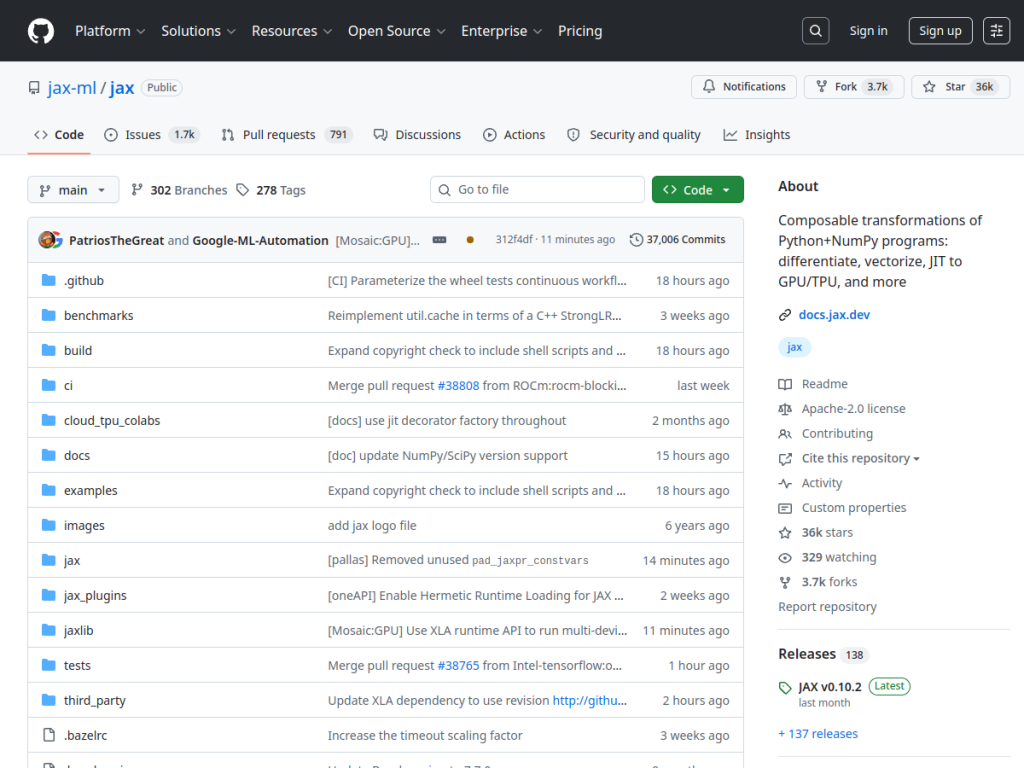
JAX is an open-source Python library from Google for high-performance numerical computing and machine learning research. Its core idea is composable function transformations applied to normal, NumPy-style Python code: grad for automatic differentiation (including higher-order derivatives), jit for just-in-time compilation via XLA (delivering major speedups), vmap for automatic vectorization (batching without rewriting code), and pmap/sharding for parallelizing across multiple devices. It runs on CPUs, GPUs, and TPUs, and its functional programming style (pure functions, immutable arrays) enables these transformations to compose cleanly. A rich ecosystem has grown around it — including neural network libraries such as Flax and optimizers like Optax — and it underpins significant AI research, including work at Google DeepMind. It suits researchers who need mathematical flexibility and performance, and its functional style differs from more imperative frameworks. JAX is free and open-source (Apache 2.0).
What it does well
- Composable transformations: grad, jit, vmap, and parallelism.
- Fast: XLA just-in-time compilation for major speedups.
- Scales: runs across CPUs, GPUs, and TPUs.
- Free and open-source: with a rich ecosystem (Flax, Optax).
Who it is for
JAX fits machine-learning researchers, computational scientists, and engineers who need high performance and mathematical flexibility — automatic differentiation, JIT compilation, vectorization, and multi-device scaling — while writing clean, NumPy-like Python. It is especially strong for research and for TPU workloads. Its functional style (pure functions, immutable arrays) takes adjustment for those used to imperative frameworks, and beginners may find more conventional frameworks gentler, but for researchers who want speed and expressive power, JAX is an excellent, free choice.
Things to keep in mind
- Its functional style takes adjustment coming from imperative frameworks.
- It is research-oriented; beginners may find other frameworks gentler.
- You supply your own hardware or cloud compute.
Our verdict
JAX is a powerful, elegant library that researchers love for good reason: write clean NumPy-style Python, then compose transformations — grad for automatic differentiation, jit for XLA compilation and major speedups, vmap for effortless vectorization, and sharding for multi-device parallelism — scaling across CPUs, GPUs, and TPUs. A rich ecosystem (Flax, Optax) and its role underpinning serious AI research, including at DeepMind, speak to its power. Its functional style takes adjustment and it leans research-oriented, but for high-performance, flexible ML computing, JAX is an excellent, free choice.
Frequently asked questions
What is JAX?
JAX is Google’s open-source Python library for high-performance numerical computing and ML, combining NumPy-style code with automatic differentiation, JIT compilation, and device parallelism.
What makes JAX distinctive?
Its composable function transformations: grad (autodiff), jit (XLA compilation for speed), vmap (automatic vectorization), and parallelism across GPUs and TPUs.
Is JAX free?
Yes, JAX is free and open-source (Apache 2.0); you run it on your own hardware or any cloud.
Who is JAX for?
It is for ML researchers, computational scientists, and engineers who need performance and mathematical flexibility, especially for research and TPU workloads.
Top JAX alternatives
Other hand-reviewed Coding Assistants tools worth comparing against JAX.
AiderFree
Aider is a free AI coding assistant and developer tool tool for software developers. Our review covers what…
AlphaCodeFree
AlphaCode by Google DeepMind is a free AI coding assistant and developer tool tool for software developers. Our…
Amazon Q DeveloperFreemium
Amazon Q Developer by Amazon Web Services is a freemium AI business and coding assistant tool for software…
AnacondaFree
Anaconda is a free AI coding assistant and developer tool tool for engineers. Our review covers what it…
ApplitoolsPaid
Applitools is a paid AI coding assistant and developer tool tool for engineers. Our review covers what it…
AskCodiFreemium
AskCodi is a freemium AI coding assistant and developer tool tool for software developers. Our review covers what…
Are you the maker of JAX?
Show visitors this review with the badge below. Copy the code into your site or press kit; it links straight back to this page.