Key Takeaways
- Applitools is an AI-powered software testing platform built around Visual AI.
- Its Eyes product catches visual and functional bugs across browsers and devices without brittle checks.
- Applitools Autonomous adds AI-driven test creation, execution, and self-healing maintenance.
- Excellent for QA and engineering teams; it complements, not replaces, existing test frameworks.
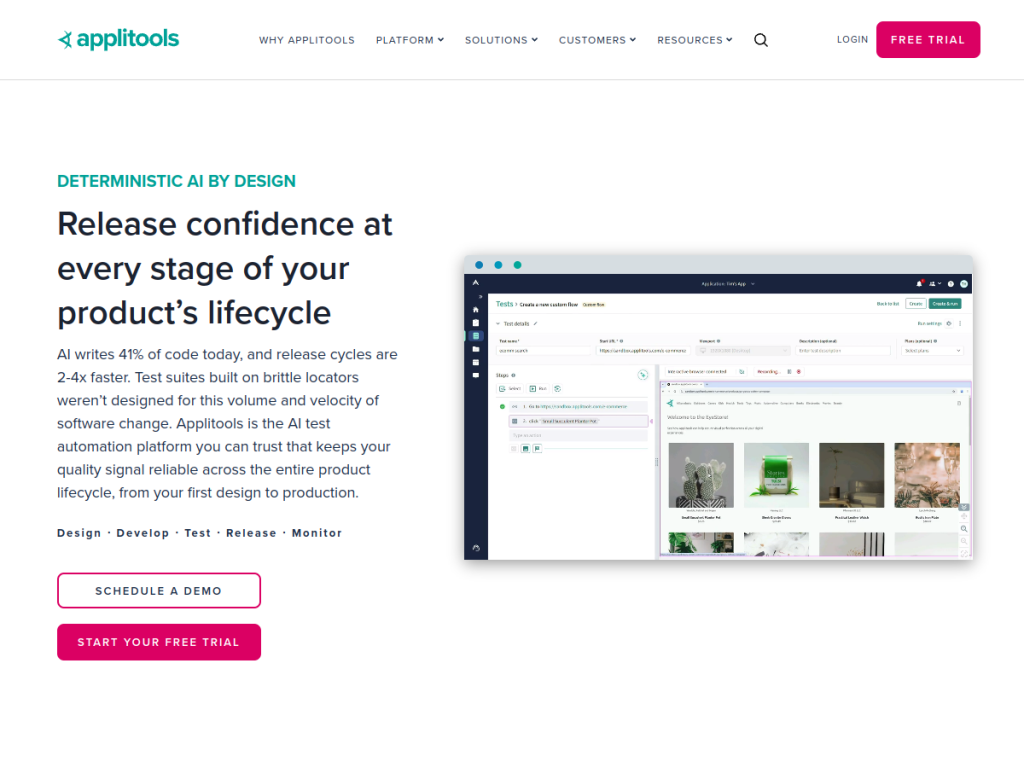
Applitools is a testing platform that uses AI to validate what users actually see. Its Visual AI compares application screens intelligently — catching real visual and functional regressions while ignoring harmless differences — and its newer autonomous testing adds AI-driven test creation and self-healing. The pitch it emphasizes is “deterministic” AI: results you can reproduce, not probabilistic guesses.
What is Applitools?
Applitools is an AI-augmented testing platform for validating digital experiences across web and mobile. Its flagship, Eyes, uses Visual AI to detect visual and functional differences between builds, handling dynamic content without the false positives that plague pixel-by-pixel comparison. Applitools Autonomous goes further, using AI to author, run, and analyze tests — including natural-language test building, codeless recording, and self-healing tests that adapt when the UI changes. The platform runs tests across many browser and device combinations, supports accessibility validation and root-cause analysis, and carries enterprise credentials like SOC 2 Type II and ISO 27001, with SaaS, dedicated-cloud, and on-premises deployment options.
What it does well
- Visual AI: catches real UI regressions while ignoring irrelevant noise.
- Cross-environment coverage: one visual checkpoint validated across many browsers and devices.
- Self-healing tests: AI adapts tests to UI changes, cutting maintenance.
- Enterprise readiness: strong compliance and flexible deployment options.
Who it is for
Applitools is built for QA engineers, test automation teams, and development organizations that ship user interfaces frequently and need to catch visual and functional regressions before users do. It is especially valuable for teams testing across many browser/device combinations or maintaining large, brittle test suites. It is less relevant to solo developers on tiny projects, where the setup may outweigh the benefit, though the free tier lets small teams try it.
Things to keep in mind
- It complements test frameworks like Selenium, Cypress, or Playwright rather than replacing them.
- Enterprise pricing is quote-based; budget planning means talking to sales.
- Getting the most from Visual AI takes some initial setup and baseline management.
Our verdict
Applitools is one of the strongest AI testing platforms available, and its Visual AI genuinely solves a hard problem: catching the UI regressions that traditional automation misses while avoiding false alarms. The autonomous, self-healing features push it further by cutting the maintenance burden that sinks many test suites. For QA and engineering teams shipping frequently across many environments, it is well worth adopting; smaller projects can start on the free tier and scale up as testing needs grow.
Frequently asked questions
What does Applitools do?
Applitools is an AI-powered testing platform that uses Visual AI to catch visual and functional bugs across browsers and devices, plus autonomous, self-healing test creation.
What is Applitools Eyes?
Eyes is Applitools’ core product: it uses Visual AI to compare application screens across builds and environments, flagging real regressions while ignoring irrelevant differences.
Does Applitools replace Selenium or Cypress?
No. It complements frameworks like Selenium, Cypress, and Playwright, adding intelligent visual validation and reducing test maintenance rather than replacing them.
Is there a free version of Applitools?
Yes. A free tier is available for smaller projects, with team and enterprise plans quoted based on needs, plus free trials of the full platform.
Top Applitools alternatives
Other hand-reviewed Coding Assistants tools worth comparing against Applitools.
AiderFree
Aider is a free AI coding assistant and developer tool tool for software developers. Our review covers what…
AlphaCodeFree
AlphaCode by Google DeepMind is a free AI coding assistant and developer tool tool for software developers. Our…
Amazon Q DeveloperFreemium
Amazon Q Developer by Amazon Web Services is a freemium AI business and coding assistant tool for software…
AnacondaFree
Anaconda is a free AI coding assistant and developer tool tool for engineers. Our review covers what it…
AskCodiFreemium
AskCodi is a freemium AI coding assistant and developer tool tool for software developers. Our review covers what…
Azure MLPaid
Azure ML by Microsoft Azure is a paid AI coding assistant and developer tool tool for engineers. Our…
Are you the maker of Applitools?
Show visitors this review with the badge below. Copy the code into your site or press kit; it links straight back to this page.