Key takeaways
- Turnitin is the long-established academic-integrity platform for plagiarism detection, used by 16,000+ institutions.
- It has added AI-writing detection and tools like Turnitin Clarity for responsible, customisable AI use in assignments.
- Beyond detection it offers grading, feedback and writing-analytics tools integrated into education workflows.
- Its AI detection, like all such tools, is probabilistic — institutions should use it fairly, not as automatic proof.
What Turnitin is
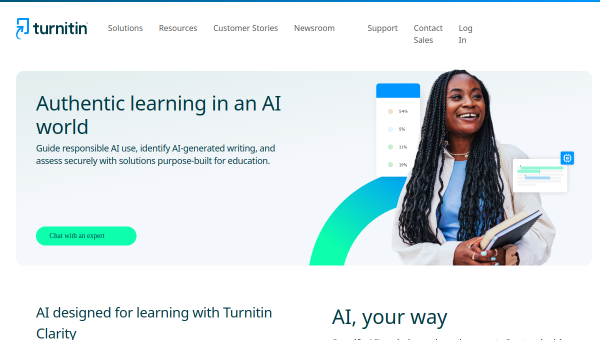
Turnitin is the dominant name in academic integrity. For over two decades it has been the standard plagiarism-detection service in education, checking student submissions against a vast database of academic papers, publications and previously submitted work, deeply integrated into learning-management systems at more than sixteen thousand institutions. Alongside plagiarism detection it offers grading, feedback and writing-analytics tools, positioning itself as a broad platform for assessment and learning integrity rather than a single-purpose checker.
In response to generative AI, Turnitin has added AI-writing detection and newer tools such as Turnitin Clarity, which is oriented toward responsible, customisable AI use in assignments rather than pure detection — letting instructors set what AI use is acceptable. That reflects a shift in the conversation from catching AI to defining appropriate AI use in education.
The AI features and their limits
Turnitin’s plagiarism detection is its most established and trusted capability, backed by its large database and long track record. Its AI-writing detection estimates the proportion of a submission that may be AI-generated. But this AI detection has been controversial: independent scrutiny and Turnitin’s own guidance acknowledge it is not infallible, false positives occur, and some institutions have limited or disabled it over accuracy and fairness concerns. Detecting AI text is fundamentally harder and less reliable than matching against a plagiarism database.
This is the crucial distinction for anyone relying on Turnitin. Its plagiarism matching, while still requiring human interpretation of context and citation, is comparatively dependable. Its AI-detection score is probabilistic and should never be treated as proof that a student used AI. Responsible institutions use it as one input to an educational conversation, protected by fair processes and human judgment — and Turnitin’s move toward tools like Clarity reflects a healthier framing than detection alone.
Strengths and limits
The strengths are Turnitin’s unmatched plagiarism database, deep LMS integration, institutional trust and its broader grading and feedback tools. For plagiarism detection and assessment workflows at scale, it remains the standard, and its pivot toward defining acceptable AI use is a constructive direction.
The limits centre on AI detection: it is probabilistic, has documented false positives, and has drawn enough concern that some schools have disabled it. Even plagiarism matches need human review of context. Turnitin is an institutional platform, not an individual tool, and its considerable influence means its outputs must be used carefully and fairly, especially where a student’s record is at stake.
Who it suits
- Educational institutions needing established plagiarism detection at scale.
- Instructors who want grading, feedback and integrity tools integrated with their LMS.
- Schools defining acceptable AI use with tools like Turnitin Clarity.
Verdict
Turnitin remains the standard for academic-integrity and plagiarism detection, with an unmatched database, deep institutional integration and a growing set of grading, feedback and responsible-AI tools. Its plagiarism matching is dependable (with human interpretation); its AI-writing detection, like all such tools, is probabilistic and has documented false positives, which is why some institutions limit it. The right use is as one signal within a fair, human-led process — never as automatic proof of AI use. For institutions, Turnitin is a powerful platform, best used with care and sound judgment.
Top Turnitin alternatives
Other hand-reviewed AI Education tools worth comparing against Turnitin.
BrainlyFreemium
Brainly is a freemium AI education tool. Our hands-on review covers features, pricing, pros and cons, and who…
CheggPaid
Chegg is a paid AI education tool. Our hands-on review covers features, pricing, pros and cons, and who…
Course HeroFreemium
Course Hero is a freemium AI education tool. Our hands-on review covers features, pricing, pros and cons, and…
GauthFree
Gauth is a free AI education tool. Our hands-on review covers features, pricing, pros and cons, and who…
MindgraspFree Trial
Mindgrasp is a free trial AI education tool. Our hands-on review covers features, pricing, pros and cons, and…
ReviselyFree
Revisely is a free AI education tool. Our hands-on review covers features, pricing, pros and cons, and who…
Are you the maker of Turnitin?
Show visitors this review with the badge below. Copy the code into your site or press kit; it links straight back to this page.