Key Takeaways
- Genmo is an AI company building video generation models.
- Its flagship, Mochi 1, is a state-of-the-art open text-to-video model.
- You can try it in a web playground or run the open weights yourself.
- Great for creators and developers exploring open AI video generation.
Genmo is an AI company focused on video generation, best known for Mochi — a leading open text-to-video model. Type a description and Genmo turns it into video, and because Mochi is open-source, developers can run and customize it themselves. For creators and technical users who want cutting-edge, open AI video generation rather than a closed, black-box service, Genmo is a notable option.
What is Genmo?
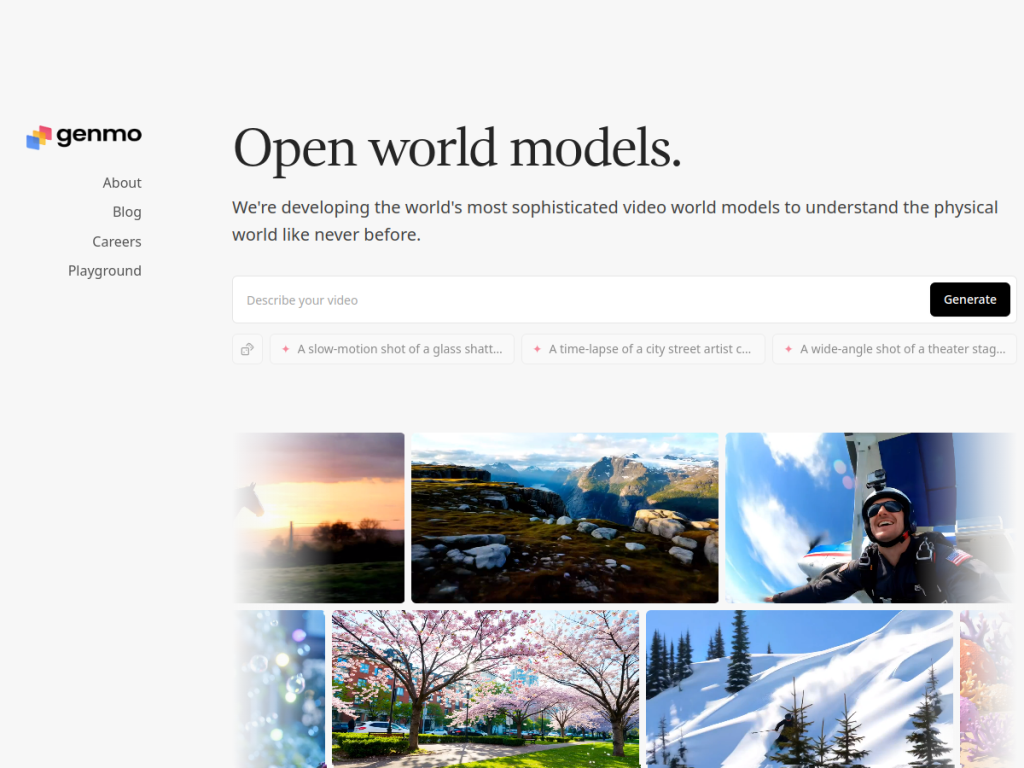
Genmo is an AI company developing video generation models, with its primary product being Mochi 1, described as a new state of the art in open text-to-video generation. It converts written descriptions into video content, and its open-source nature is a key differentiator: Mochi is available on GitHub and Hugging Face so users can run and customize it locally, and it supports deployment options including ComfyUI integration. Genmo provides an interactive web-based playground for testing capabilities without setup, alongside the open-weights route for developers who want full control. The company emphasizes open-source accessibility and continues to advance its video world models. Genmo offers a free playground and open-source weights, with commercial or higher-volume use potentially involving paid options.
What it does well
- Open text-to-video: a leading open model in Mochi.
- Self-hostable: run and customize the open weights yourself.
- Easy to try: a web playground with no setup required.
- Developer-friendly: GitHub, Hugging Face, and ComfyUI options.
Who it is for
Genmo fits AI creators, developers, and researchers who want to explore text-to-video generation with an open model they can test in a playground or run and customize themselves — rather than being limited to a closed commercial service. Its open-source approach appeals to those who value control and experimentation. Users wanting the most polished, turnkey commercial video product with heavy support may prefer closed platforms, and running models locally requires capable hardware, but for open, cutting-edge AI video generation, Genmo is a compelling, free-to-try choice.
Things to keep in mind
- Running the open model locally requires capable GPU hardware.
- AI video generation is fast-moving; capabilities and quality keep evolving.
- A closed commercial service may offer more polish and support for some users.
Our verdict
Genmo is a notable player in AI video, and its open text-to-video model, Mochi, is its standout: a state-of-the-art open model you can test in a web playground or run and customize yourself via GitHub, Hugging Face, or ComfyUI. For creators and developers who value openness and control over a closed service, that is a real draw. Local use needs capable hardware and the field is evolving quickly, but for exploring cutting-edge, open AI video generation, Genmo is a compelling, free-to-try option.
Frequently asked questions
What is Genmo?
Genmo is an AI company building video generation models, best known for Mochi 1, a state-of-the-art open text-to-video model that turns text descriptions into video.
Is Genmo’s model open-source?
Yes, Mochi is available as open weights on GitHub and Hugging Face, so developers can run and customize it locally, including via ComfyUI.
How can I try Genmo?
You can try it in Genmo’s interactive web playground without setup, or run the open-source model yourself for full control.
Is Genmo free?
Genmo offers a free playground and open-source weights, with commercial or higher-volume use potentially involving paid options.
Top Genmo alternatives
Other hand-reviewed Social Media tools worth comparing against Genmo.
AdCreative.aiPaid
AdCreative.ai is a paid AI design and marketing tool for marketers. Our review covers what it does, pricing,…
BoomyFreemium
Boomy is a freemium AI audio music and social media tool for musicians and producers. Our review covers…
Brand24Paid
Brand24 is a paid AI marketing and social media tool for marketers. Our review covers what it does,…
Buffer AIFreemium
Buffer AI is a freemium AI marketing and productivity tool for social media managers. Our review covers what…
Canva AIFreemium
Canva AI is a freemium AI design and image generation tool for designers. Our review covers what it…
Captions AIFreemium
Captions AI is a freemium AI avatars and social media tool for video creators. Our review covers what…
Are you the maker of Genmo?
Show visitors this review with the badge below. Copy the code into your site or press kit; it links straight back to this page.