Key Takeaways
- Keras is a popular, human-friendly deep learning API for building neural networks.
- Keras 3 runs on multiple backends — JAX, TensorFlow, and PyTorch.
- It is open source, free, and widely used in research and production.
- Excellent for building and training models readably; it is a developer library, not an app.
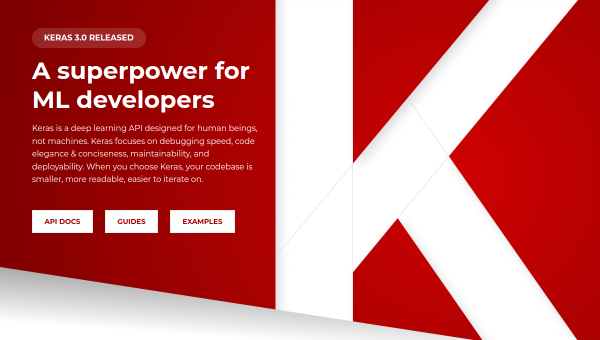
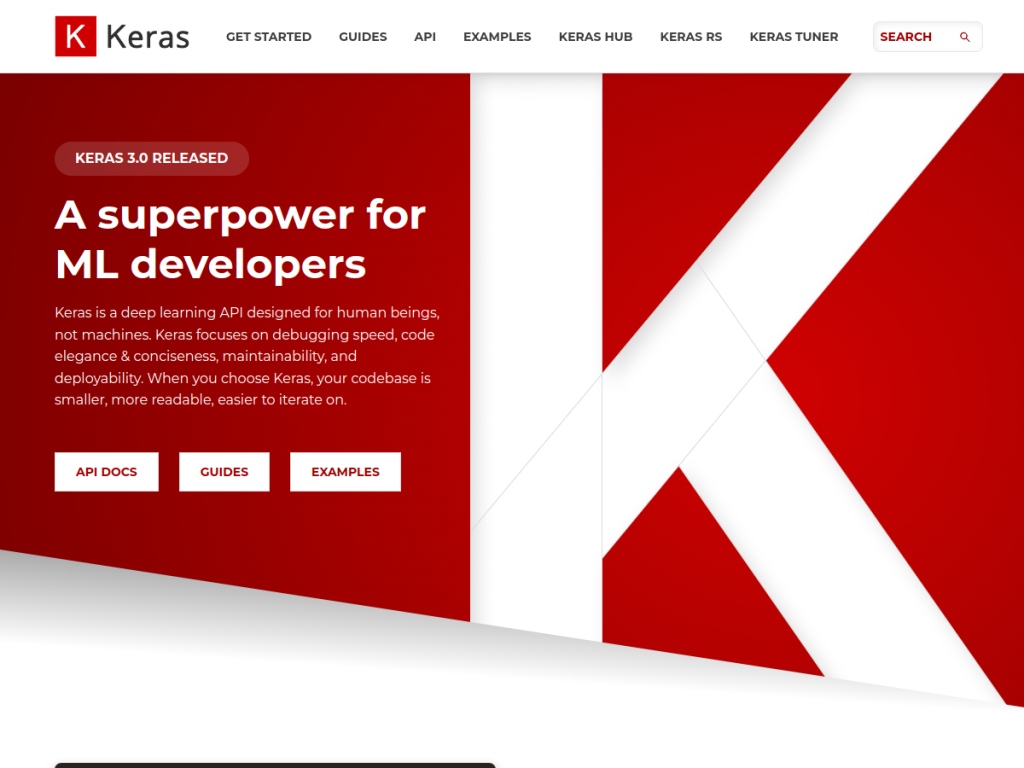
Keras is one of the most loved deep learning frameworks, designed “for human beings, not machines” — prioritizing readable, concise code that is fast to debug and easy to maintain. With Keras 3 it runs on top of JAX, TensorFlow, or PyTorch, letting developers build and train neural networks without being locked into a single ecosystem.
What is Keras?
Keras is a high-level deep learning API for building, training, and deploying neural networks, emphasizing simplicity and readability. Keras 3 is multi-backend, working seamlessly across JAX, TensorFlow, and PyTorch, so models can move between ecosystems. It offers a Functional API for composing models, built-in training and evaluation methods, and custom layer and model creation via subclassing, plus pre-built architectures and pretrained models through KerasHub (including Gemma, Llama, Stable Diffusion, and Mistral). It is open source, free, actively maintained with public roadmaps, and trusted by major scientific and industry organizations — from CERN and NASA to Google, Netflix, and Uber — and partners with communities like Kaggle and Hugging Face. Keras is prized for smaller, more readable codebases that suit both research and production.
What it does well
- Readable API: concise, human-friendly code that is fast to debug.
- Multi-backend: Keras 3 runs on JAX, TensorFlow, and PyTorch.
- Pretrained models: KerasHub offers modern architectures like Gemma and Llama.
- Open source and free: widely used in research and production.
Who it is for
Keras is for machine-learning engineers, researchers, and developers who want to build and train neural networks with clean, maintainable code — from students learning deep learning to teams shipping models in production. Its multi-backend flexibility appeals to those who want to avoid ecosystem lock-in. It is a developer library rather than a ready-made application, so non-programmers will not use it directly, but for building deep learning models, Keras is a top choice.
Things to keep in mind
- It is a developer framework, so it requires programming and ML knowledge.
- Costs are indirect — you pay for the compute you run models on.
- Very low-level customizations may still drop into the underlying backend.
Our verdict
Keras remains one of the best deep learning frameworks for a reason: it makes building and training neural networks approachable through clean, readable code, and Keras 3’s multi-backend support across JAX, TensorFlow, and PyTorch adds real flexibility. Free, open source, and battle-tested at major organizations, with modern pretrained models via KerasHub, it suits both research and production. It is a developer library that assumes ML knowledge, but for anyone building deep learning models, Keras is an excellent, free choice.
Frequently asked questions
What is Keras?
Keras is a high-level, human-friendly deep learning API for building and training neural networks, with Keras 3 running on JAX, TensorFlow, and PyTorch.
Is Keras free?
Yes. Keras is open source and free to use; the only costs are the compute you run your models on.
What backends does Keras support?
Keras 3 is multi-backend, working across JAX, TensorFlow, and PyTorch, so models can move between ecosystems.
Does Keras offer pretrained models?
Yes. Through KerasHub, Keras provides pre-built architectures and pretrained models, including Gemma, Llama, Stable Diffusion, and Mistral.
Top Keras alternatives
Other hand-reviewed Coding Assistants tools worth comparing against Keras.
AiderFree
Aider is a free AI coding assistant and developer tool tool for software developers. Our review covers what…
AlphaCodeFree
AlphaCode by Google DeepMind is a free AI coding assistant and developer tool tool for software developers. Our…
Amazon Q DeveloperFreemium
Amazon Q Developer by Amazon Web Services is a freemium AI business and coding assistant tool for software…
AnacondaFree
Anaconda is a free AI coding assistant and developer tool tool for engineers. Our review covers what it…
ApplitoolsPaid
Applitools is a paid AI coding assistant and developer tool tool for engineers. Our review covers what it…
AskCodiFreemium
AskCodi is a freemium AI coding assistant and developer tool tool for software developers. Our review covers what…
Are you the maker of Keras?
Show visitors this review with the badge below. Copy the code into your site or press kit; it links straight back to this page.