Key takeaways
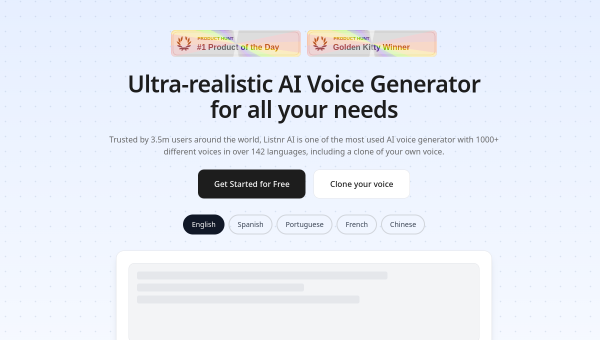
- Listnr is a text-to-speech platform with 1,000+ AI voices across 140+ languages and accents.
- It offers voice cloning, emotion and style controls, custom pronunciations and multi-voice conversations.
- Generated audio comes with full commercial-use rights — useful for audiobooks, podcasts and voiceovers.
- Best for creators, educators and businesses needing versatile, commercially usable AI narration.
What Listnr is
Listnr is a cloud-based text-to-speech platform that converts written content into realistic AI narration. Its headline is scale and versatility: over a thousand AI voices spanning more than 140 languages and accents, aimed at everything from audiobooks and podcasts to video voiceovers, gaming and accessibility. It reports millions of users and partnerships and recognition that lend it credibility. For creators who need narration in many voices and languages from one tool, Listnr covers a lot of ground.
Its positioning is a broad, general-purpose voice generator with the practical features creators need — not just raw text-to-speech, but control over how the voice sounds and clear commercial rights to use the output. That combination makes it a versatile option across content types.
The AI features
Beyond its large multilingual voice library, Listnr offers voice cloning to create a custom voice from your own, and fine-grained customisation: emotion tuning, speech styles, custom pronunciations, and pitch and rate control. Multi-voice conversations let you build dialogue between different voices — useful for scripted podcasts or character narration. Importantly, generated audio comes with full ownership and commercial-usage rights, which removes a common source of uncertainty when using AI voices in monetised content.
The emotion and pronunciation controls are what lift Listnr above basic TTS, letting you shape delivery rather than accept a flat read. As with any synthetic voice, review the output for mispronunciations and unnatural pacing, and use voice cloning responsibly — clone only your own voice or one you have clear consent to use. Confirm the specifics of the commercial rights for your plan.
Strengths and limits
The strengths are voice range, customisation and clear commercial rights. A thousand-plus voices across 140-plus languages, plus emotion and pronunciation controls and multi-voice dialogue, make Listnr flexible for many content types, and the full commercial-use rights are a genuine practical benefit for monetising creators.
The limits: with so many voices, quality varies — some sound more natural than others — so audition before committing to one. Synthetic narration still needs review for pronunciation and pacing, and voice cloning carries consent obligations. Heavier use requires a paid plan, and no AI voice fully matches a skilled human narrator for premium work.
Who it suits
- Creators making audiobooks, podcasts and video voiceovers who need commercial rights.
- Educators and businesses needing narration across many languages.
- Anyone wanting emotion and pronunciation control plus multi-voice dialogue.
Verdict
Listnr is a versatile, general-purpose AI text-to-speech platform, strong on voice range (1,000+ voices, 140+ languages), customisation (emotion, pronunciation, multi-voice) and, importantly, clear commercial-use rights. That makes it a practical choice for creators, educators and businesses producing narrated content they intend to monetise. Voice quality varies across such a large library, output needs the usual review, and cloning demands consent — but for flexible, commercially usable AI narration, Listnr is a capable and well-rounded option.
Top Listnr alternatives
Other hand-reviewed Voice & Text-to-Speech tools worth comparing against Listnr.
AlteredPaid
Altered is a paid AI video generation and voice text to speech tool for video creators. Our review…
Amazon PollyPaid
Amazon Polly by Amazon Web Services is a paid AI video generation and voice text to speech tool…
Azure TTSPaid
Azure TTS by Microsoft Azure is a paid AI video generation and voice text to speech tool for…
CoquiFree
Coqui by Coqui (community-maintained) is a free AI video generation and voice text to speech tool for video…
DescriptFreemium
Descript is a freemium AI social media and video generation tool for video creators. Our review covers what…
Designs.aiPaid
Designs.ai is a paid AI branding and design tool for brand creators. Our review covers what it does,…
Are you the maker of Listnr?
Show visitors this review with the badge below. Copy the code into your site or press kit; it links straight back to this page.