Key takeaways
- Originality.ai combines AI-content detection with plagiarism checking, fact-checking and quality scoring for content teams.
- Features include bulk scanning, an adjustable AI allowance, team management, API access and a Chrome extension with editing replay.
- It is aimed at publishers, agencies and marketers policing content quality and authenticity at scale.
- Like all AI detectors, its accuracy claims are self-reported — use scores as one signal, not definitive proof.
What Originality.ai is
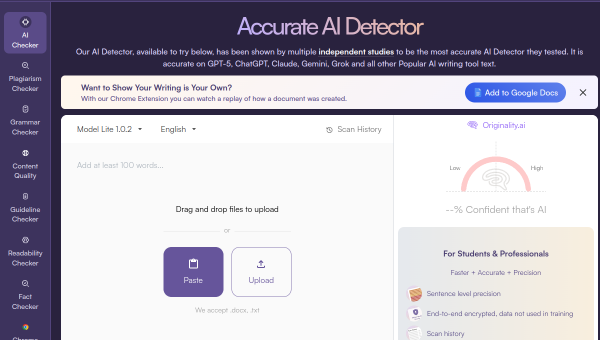
Originality.ai is a content-integrity platform built more for professional content teams than for classrooms. It combines AI-content detection with a plagiarism checker, and adds fact-checking, content-quality scoring, grammar and readability tools. Its features lean toward scale and workflow: bulk scanning of many documents, an adjustable “AI allowance” that lets you set an acceptable AI percentage, team management, API access and a Chrome extension that tracks Google Docs writing with character-by-character replay. Its users are publishers, agencies, marketers and enterprises.
The positioning is content operations: helping publishers and agencies ensure the writing they commission is human (or within an acceptable AI threshold), original and factually sound. The bulk and API features make it practical for teams processing large volumes of content rather than one-off checks.
The AI features and their limits
Originality.ai detects AI-generated text across major models and checks for plagiarism against web sources, with added fact-checking to flag questionable claims and quality scoring to gauge writing. The AI allowance and bulk scanning suit editorial workflows, and the writing-replay extension adds authorship context. The company claims high accuracy across models, and to its credit emphasises using detection as one signal among many rather than a definitive judgment.
That caveat is essential and applies to every detector. Independent evaluations of AI detectors show false positives and evasion are real, accuracy varies by model and text length, and paraphrasing tools can defeat them. Originality.ai’s accuracy figures are self-reported, so treat them cautiously. For editorial use, the stakes of a false positive are lower than in academia, but fairness still demands that a score inform a human review rather than automatically condemn a writer.
Strengths and limits
The strengths are the team-oriented feature set and breadth. Bulk scanning, API, team management, an adjustable AI threshold, plus plagiarism and fact-checking, make Originality.ai genuinely useful for content operations at scale — more than a single-purpose detector. The workflow focus fits agencies and publishers well.
The limits are those of AI detection generally: probabilistic results, false positives, evasion, and self-reported accuracy. Fact-checking and quality scoring are helpful but not infallible and need human verification. It is a strong operational tool when its outputs are treated as signals to guide editors, not as automatic verdicts on writers or content.
Who it suits
- Publishers and agencies checking commissioned content at scale.
- Content teams that want AI detection, plagiarism and fact-checking together.
- Marketers who need bulk scanning, an AI threshold and API access.
Verdict
Originality.ai is a capable content-integrity platform for professional teams, combining AI detection with plagiarism checking, fact-checking and quality scoring, plus bulk scanning, an adjustable AI allowance and API access for scale. It is well suited to publishers and agencies policing content quality. As with every AI detector, its accuracy claims are self-reported and false positives are a genuine risk, so use its scores as one signal to guide human editors — not as definitive proof. Within that frame, it is one of the more practical tools for content operations.
Top Originality.ai alternatives
Other hand-reviewed Writing Assistants tools worth comparing against Originality.ai.
AI21 LabsPaid
AI21 Labs is a paid AI marketing and writing assistant tool for writers and marketers. Our review covers…
AnywordPaid
Anyword is a paid AI marketing and writing assistant tool for writers and marketers. Our review covers what…
Article ForgePaid
Article Forge by Glimpse is a paid AI marketing and writing assistant tool for writers and marketers. Our…
BlogelyPaid
Blogely is a paid AI marketing and writing assistant tool for writers and marketers. Our review covers what…
BywordPaid
Byword is a paid AI marketing and writing assistant tool for writers and marketers. Our review covers what…
ChatGPTFreemium
ChatGPT by OpenAI is a freemium AI assistant and chatbot tool for writers and marketers. Our review covers…
Are you the maker of Originality.ai?
Show visitors this review with the badge below. Copy the code into your site or press kit; it links straight back to this page.