
Key Takeaways
- StealthWriter rewrites AI-generated text to sound more human.
- It is marketed to help text evade AI-content detectors.
- It also scores text against detection tools.
- Use with real caution — detection evasion carries serious risks.
StealthWriter is an “AI humanizer” — a tool that rewrites AI-generated text to read as more human and, explicitly, to bypass AI-content detectors. This category needs an honest, upfront review: while rewriting can improve awkward AI phrasing, the core marketed purpose — disguising AI text to evade detection — carries real academic-integrity, professional, and trust risks, and detectors themselves are unreliable. We cover what it does, but the caveats here are not incidental; they are central.
What is StealthWriter?
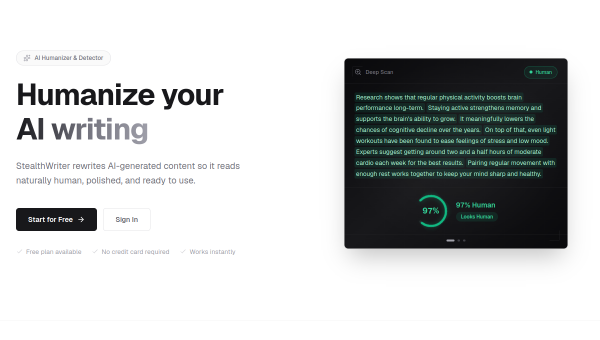
StealthWriter is an AI text “humanizer” tool designed to rewrite AI-generated content so it reads as more natural and human-written, with the explicit marketed goal of helping text pass AI-content detectors (such as those used to flag AI-generated writing). It typically works by paraphrasing and restructuring AI output using its own models (marketed under names like “Ghost”), aiming to remove the statistical patterns detectors look for, and it often includes a built-in detection score estimating whether the output would be flagged. It is used by people who have generated text with AI and want it to appear human-written. An honest assessment must foreground the concerns rather than bury them. First, the primary use case — evading AI detection — raises serious issues: in academic settings it typically violates academic-integrity policies and can constitute misconduct; in professional and publishing contexts it can breach disclosure expectations and platform rules and damage trust. Second, AI detectors are themselves notoriously unreliable (producing false positives and negatives), so the entire “detection vs. evasion” arms race rests on shaky ground. Third, rewritten text can lose accuracy or meaning and still requires careful review. It targets students, writers, and marketers — but responsible use is narrow. StealthWriter offers limited free use with paid plans.
What it does well
- Rewrites awkward AI phrasing into smoother text.
- Includes a built-in AI-detection score.
- Multiple rewriting models and modes.
- Free tier to test its output.
Who it is for
Honestly, this is a tool to approach with real caution rather than recommend broadly. Any legitimate use is narrow — for example, smoothing genuinely awkward machine phrasing in your own work that you will still review and take responsibility for. Its core marketed purpose, disguising AI text to evade detection, is where the serious problems lie: students using it to pass off AI work typically violate academic-integrity policies and risk misconduct findings; professionals and publishers risk breaching disclosure rules and platform terms and damaging trust. Add that AI detectors are themselves unreliable, and the whole evasion premise is shaky. If you use it at all, do so transparently and within the rules that apply to you — never to deceive.
Things to keep in mind
- Evading AI detection can violate academic-integrity and professional rules.
- AI detectors are unreliable, making the whole evasion premise shaky.
- Rewritten text can lose accuracy and still needs careful review.
Our verdict
StealthWriter does what it advertises — rewriting AI text to read more human and to slip past AI detectors, with a built-in detection score — but an honest review has to foreground the concerns, not the features. The primary marketed purpose, evading detection, carries real risks: in academic settings it typically breaches integrity policies and can be misconduct; in professional and publishing contexts it can violate disclosure rules and erode trust. And because AI detectors are themselves notoriously unreliable, the entire arms race stands on shaky ground. There are narrow, transparent uses for smoothing your own reviewed writing, but as a detection-evasion tool, StealthWriter is one to approach with real caution.
Frequently asked questions
What is StealthWriter?
StealthWriter is an AI “humanizer” that rewrites AI-generated text to read as more human and, as marketed, to bypass AI-content detectors, including a built-in detection score.
Is it OK to use StealthWriter to pass off AI work?
No — using it to disguise AI work typically violates academic-integrity policies (and can be misconduct) and can breach professional or publishing disclosure rules and damage trust. Use AI transparently and within the rules that apply to you.
Do AI detectors actually work?
AI detectors are notoriously unreliable, producing false positives and negatives, which is one reason the whole “detection vs. evasion” arms race rests on shaky ground.
Is StealthWriter free?
StealthWriter offers limited free use, with paid plans for more words and features.
Top StealthWriter alternatives
Other hand-reviewed Writing Assistants tools worth comparing against StealthWriter.
AI21 LabsPaid
AI21 Labs is a paid AI marketing and writing assistant tool for writers and marketers. Our review covers…
AnywordPaid
Anyword is a paid AI marketing and writing assistant tool for writers and marketers. Our review covers what…
Article ForgePaid
Article Forge by Glimpse is a paid AI marketing and writing assistant tool for writers and marketers. Our…
BlogelyPaid
Blogely is a paid AI marketing and writing assistant tool for writers and marketers. Our review covers what…
BywordPaid
Byword is a paid AI marketing and writing assistant tool for writers and marketers. Our review covers what…
ChatGPTFreemium
ChatGPT by OpenAI is a freemium AI assistant and chatbot tool for writers and marketers. Our review covers…
Are you the maker of StealthWriter?
Show visitors this review with the badge below. Copy the code into your site or press kit; it links straight back to this page.