

Key Takeaways
- Tavus builds real-time conversational AI video agents with human-like faces.
- Its models handle facial rendering, perception, and natural conversation timing.
- A developer API and a no-code PAL Maker let you build video agents.
- Cutting-edge for face-to-face AI; it is a developer and enterprise platform.
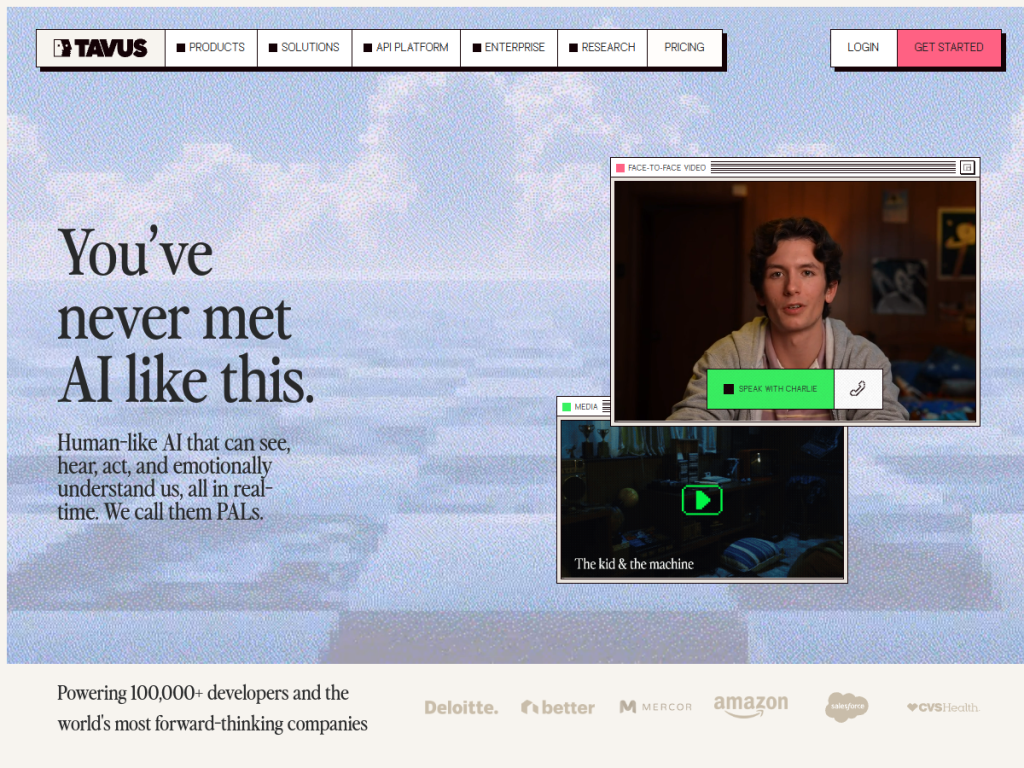
Tavus is pushing one of the more striking frontiers of AI: making computers you can talk to face to face. Rather than a text chatbot, Tavus creates real-time conversational video agents — human-like AI characters that see, listen, understand, and respond with a rendered face and natural timing — aimed at interactions that feel less like using software and more like talking to a person.
What is Tavus?
Tavus is an AI company building human-like conversational video agents, which it calls PALs. Its platform lets developers create real-time video agents with perception, understanding, voice, and rendering through a developer API, or build them without code via PAL Maker in minutes, alongside bespoke enterprise deployments for workflows like sales, healthcare, HR, and interviews. The technology rests on proprietary models: Phoenix for real-time facial rendering with emotional expression, Raven for multimodal perception (seeing, hearing, and reading emotion), and Sparrow for conversational timing and natural turn-taking. The result is AI you interact with face to face rather than through text. Tavus lists major enterprise clients and offers a free tier to try, with paid and usage-based pricing for production and enterprise deployments.
What it does well
- Face-to-face AI: real-time conversational video agents, not just text.
- Strong tech stack: rendering, perception, and natural conversation timing.
- Build options: a developer API plus a no-code PAL Maker.
- Enterprise-ready: bespoke deployments for real business workflows.
Who it is for
Tavus fits developers, product teams, and enterprises that want to build face-to-face conversational AI experiences — for customer interactions, onboarding, healthcare, HR, interviews, and more. It is for those who see value in a human-like video interface over plain text or voice. Casual users have nothing to build here directly; it is a developer and enterprise platform, and video agents raise design and disclosure considerations, but for teams building the next generation of human-like AI interfaces, Tavus is a leading, forward-looking choice.
Things to keep in mind
- It is a developer and enterprise platform, not a consumer app.
- Human-like video agents raise real design, ethics, and disclosure questions.
- Production use is priced by usage and can scale with volume.
Our verdict
Tavus is at the cutting edge of conversational AI, turning interactions from text into real-time, face-to-face video with human-like agents built on genuinely impressive rendering, perception, and timing technology. For developers and enterprises that want to build interfaces that feel like talking to a person — in sales, healthcare, HR, and beyond — it is a compelling platform, backed by serious clients. It is developer- and enterprise-focused rather than a consumer tool, and human-like agents demand thoughtful, transparent design, but for building the next generation of AI interfaces, Tavus is a standout with a free tier to explore.
Frequently asked questions
What is Tavus?
Tavus builds real-time conversational AI video agents — human-like characters you interact with face to face — via a developer API and a no-code PAL Maker.
What can you build with Tavus?
You can build real-time video agents for use cases like sales, onboarding, healthcare, HR, and interviews, using its API or no-code tools, plus bespoke enterprise deployments.
What technology powers Tavus?
Tavus uses proprietary models for real-time facial rendering, multimodal perception, and natural conversational timing, enabling face-to-face AI interactions.
Is Tavus free?
Tavus offers a free tier to try, with paid and usage-based API pricing for production and bespoke enterprise deployments.