Key takeaways
- Google Translate is the most widely used free AI translation service, covering 100+ languages across web and mobile.
- Beyond text it offers camera translation, real-time conversation mode, voice input, handwriting, and document and website translation.
- Offline language packs and cross-device saved translations make it especially handy for travel.
- Unbeatable for free, convenient everyday translation; for professional accuracy, dedicated tools and human review are better.
What Google Translate is
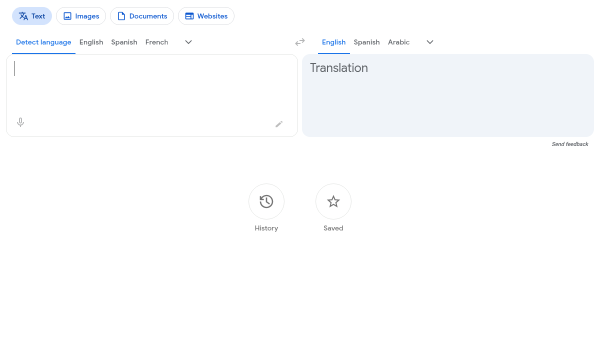
Google Translate is the default translation tool for much of the world — free, ubiquitous, and available in a browser and as mobile apps across more than a hundred languages. It began as text translation and has grown into a broad, AI-powered service that translates not just typed text but images (point your camera at a sign or menu), speech (real-time conversation mode), handwriting, documents (with formatting preserved) and entire websites. Its audience is essentially everyone: travellers, students, multilingual families, and anyone who occasionally needs to understand or communicate in another language.
Its greatest strengths are accessibility and breadth. Being free, built into Google’s ecosystem, and packed with practical modes like camera and offline translation makes it extraordinarily convenient for everyday use. For quickly understanding foreign text or getting by while travelling, nothing matches its reach and ease.
The AI features
Google Translate uses AI machine translation across all its modes: text, camera-based visual translation, real-time voice conversation, speech transcription, handwriting recognition, document upload and website translation. Offline translation works after downloading language packs — invaluable when travelling without data — and saved translations sync across devices. The camera and conversation modes in particular turn translation into something you can use in the physical world, not just for pasted text.
For everyday comprehension, this is remarkably capable and improving continually. But its quality, while good, is general-purpose: it can miss nuance, mistranslate idioms, and struggle with specialised or ambiguous text, and quality varies widely by language pair. For anything important — professional, legal, medical or published content — Google Translate is a starting point to understand or draft, not a source of publication-ready accuracy. Human review or a professional tool should handle high-stakes translation.
Strengths and limits
The strengths are accessibility, breadth of modes and price. Free, everywhere, and equipped with camera, voice, offline and document translation, Google Translate is unmatched for convenient everyday use and travel. Continuous improvement keeps its quality competitive for general purposes.
The limits: general-purpose quality means it is less reliable than specialist tools like DeepL for nuanced professional text, and accuracy varies a lot across language pairs. It should never be trusted blindly for important or sensitive content, where errors carry real consequences. And using it means sending text to Google, a privacy consideration for confidential material.
Who it suits
- Anyone needing quick, free translation for everyday use or travel.
- Travellers who value camera, conversation and offline translation.
- People who want to understand foreign text or draft simple translations fast.
Verdict
Google Translate is the world’s default translator for good reason: free, ubiquitous and packed with genuinely useful modes — camera, conversation, voice, offline and document translation — across 100+ languages. For everyday comprehension and travel, it is unbeatable for convenience. Its general-purpose quality varies by language and can miss nuance, so for professional or high-stakes content, a specialist tool and human review are wiser, and confidential text raises privacy questions. But as a free, everywhere everyday translator, Google Translate remains exceptional.
Top Google Translate AI alternatives
Other hand-reviewed Translation tools worth comparing against Google Translate AI.
DeepLFreemium
DeepL is a freemium AI business and translation tool for writers and marketers. Our review covers what it…
Duolingo MaxFreemium
Duolingo Max is a freemium AI education and translation tool for students and educators. Our review covers what…
FluentCFreemium
FluentC is a freemium AI translation and writing assistant tool for writers and marketers. Our review covers what…
Mate TranslateFreemium
Mate Translate is a freemium AI translation and writing assistant tool for writers and marketers. Our review covers…
PhrasePaid
Phrase is a paid AI business and developer tool tool for business teams. Our review covers what it…
QuillBotFreemium
QuillBot is a freemium AI education and translation tool for writers and marketers. Our review covers what it…
Google Translate AI vs the competition
Are you the maker of Google Translate AI?
Show visitors this review with the badge below. Copy the code into your site or press kit; it links straight back to this page.