Key Takeaways
- Nintex is a process automation platform combining workflow, RPA, and AI.
- Its AI agents help build, run, and refine automations over time.
- It targets business processes like onboarding, approvals, and case management.
- Strong for organizations automating at scale; it is an enterprise investment.
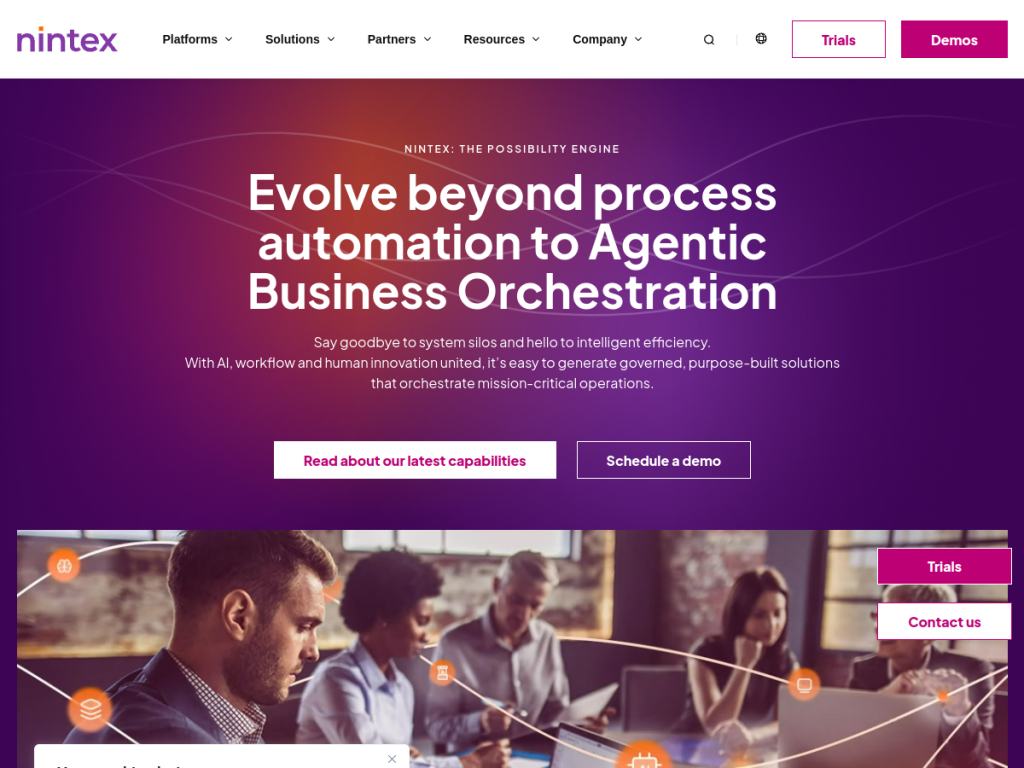
Nintex is a long-established process automation platform that helps organizations replace manual, repetitive workflows with automated ones. It has leaned into AI — describing its approach as agentic business orchestration — combining workflow automation, robotic process automation, and AI agents that build and improve automations, all with human oversight built in.
What is Nintex?
Nintex is a low-code process automation platform for eliminating manual workflows across an organization. It combines workflow automation, document automation, and robotic process automation (RPA) with AI: Nintex AI uses machine learning to make automations smarter over time by spotting patterns and suggesting improvements, and AI agents can build, run, and refine workflows in real time. The platform handles common business processes — employee onboarding, purchase approvals, case management, loan processing, contract automation, and cross-system data integration — and emphasizes low-code accessibility so both technical and non-technical staff can build automations. Trusted by thousands of companies including well-known enterprise brands, Nintex offers on-premises AI options alongside cloud, and its pricing is quote-based.
What it does well
- Broad automation: workflow, document automation, and RPA together.
- AI agents: build, run, and refine automations, improving over time.
- Low-code: accessible to technical and non-technical users alike.
- Enterprise-proven: trusted by thousands of organizations at scale.
Who it is for
Nintex fits medium-to-large organizations that want to automate repetitive, rules-based business processes across departments — operations, HR, finance, and IT — without building everything in code. It suits companies ready to invest in a platform and the process work to back it. Small businesses with simple needs will find it more than necessary; lighter no-code tools are a better starting point. For enterprises automating at scale, Nintex is a capable, established option.
Things to keep in mind
- Pricing is quote-based and aimed at organizations, not individuals.
- Real value requires mapping processes and some implementation effort.
- The shift toward AI agents is ongoing, so capabilities keep evolving.
Our verdict
Nintex is a solid, mature process automation platform, and its move toward AI agents and agentic orchestration keeps it current as automation gets smarter. The combination of workflow, document automation, and RPA under a low-code umbrella makes it versatile for organizations digitizing their operations. It is an enterprise commitment in cost and effort, and overkill for small teams, but for companies serious about automating business processes at scale — with human oversight kept in the loop — Nintex is a strong choice.
Frequently asked questions
What is Nintex?
Nintex is a low-code process automation platform that combines workflow automation, document automation, and RPA with AI agents to eliminate manual business processes.
What does Nintex AI do?
Nintex AI uses machine learning to make automations smarter over time by identifying patterns and suggesting improvements, and its AI agents can build, run, and refine workflows in real time.
Who is Nintex for?
It is for medium-to-large organizations automating repetitive processes across departments, with low-code tools accessible to both technical and non-technical users.
How much does Nintex cost?
Nintex does not publish standard pricing; plans are quote-based, so you request a demo or trial for a tailored quote.
Top Nintex alternatives
Other hand-reviewed Productivity tools worth comparing against Nintex.
Abnormal SecurityPaid
Abnormal Security by Abnormal AI is a paid AI business and productivity tool for business teams. Our review…
Adobe Acrobat AIFreemium
Adobe Acrobat AI is a freemium AI business and ocr tool for document-heavy teams. Our review covers what…
AirtableFreemium
Airtable is a freemium AI business and productivity tool for knowledge workers. Our review covers what it does,…
AlmanacPaid
Almanac is a paid AI business and productivity tool for knowledge workers. Our review covers what it does,…
AsanaFreemium
Asana is a freemium AI business and productivity tool for knowledge workers. Our review covers what it does,…
Automation AnywherePaid
Automation Anywhere is a paid AI business and productivity tool for business teams. Our review covers what it…
Are you the maker of Nintex?
Show visitors this review with the badge below. Copy the code into your site or press kit; it links straight back to this page.