Key Takeaways
- Paige builds AI for cancer diagnosis in pathology.
- It offers FDA-cleared AI tools for detecting cancer in tissue.
- It has developed large pathology foundation models.
- A serious clinical AI platform for pathologists and labs.
Paige is one of the most credible names in clinical AI, and for a serious reason: it makes AI that helps pathologists detect cancer in tissue samples, and it achieved a landmark FDA clearance for AI in pathology. This is not a consumer gadget but regulated medical technology, built with major cancer centers and validated for clinical use. For pathologists and labs, Paige represents AI applied where accuracy genuinely matters most.
What is Paige AI?
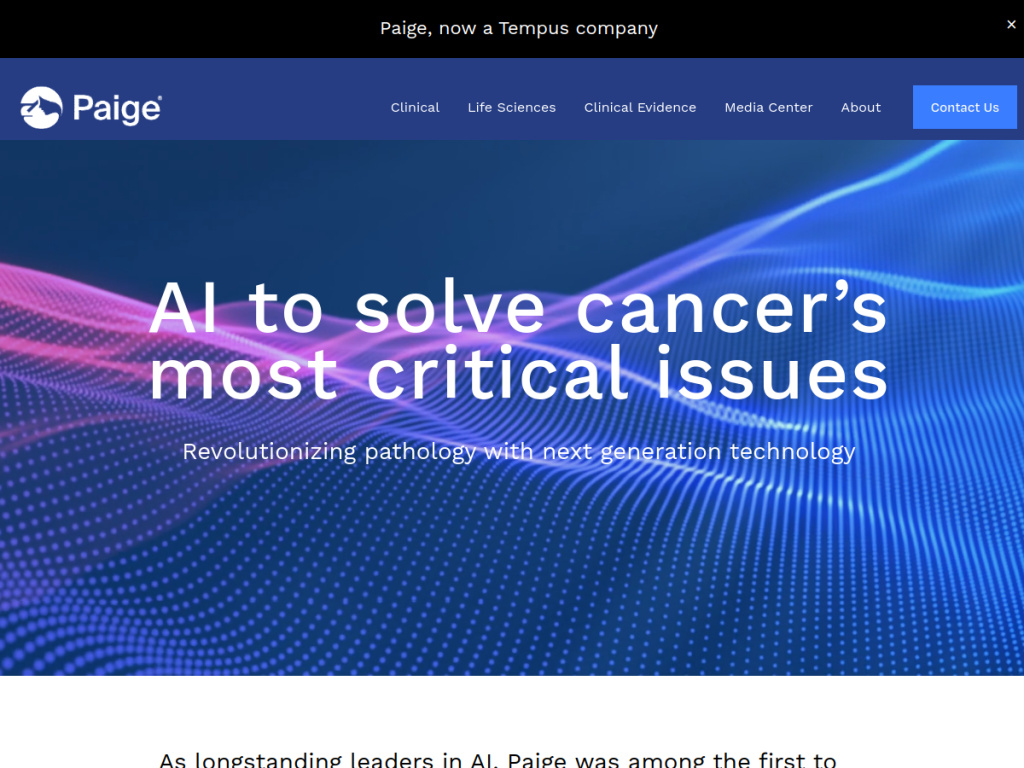
Paige is a healthcare technology company developing clinical-grade AI for pathology — the microscopic examination of tissue that underlies cancer diagnosis. Its products assist pathologists in detecting and characterizing cancer in digitized tissue slides, and it became known for achieving FDA clearance for AI in pathology (its prostate cancer detection product was a notable regulatory milestone), with a growing suite spanning cancers including prostate, breast, and others, plus broader diagnostic support. Paige has also invested heavily in pathology foundation models — large AI models trained on enormous volumes of pathology data — aimed at powering more capable and general diagnostic tools, and it offers a co-pilot-style assistant for pathologists. Developed in collaboration with leading cancer institutions and validated through clinical studies and regulatory processes, its technology is designed to work within real diagnostic workflows and digital pathology systems. It serves pathologists, hospitals, diagnostic laboratories, and life-sciences and pharmaceutical partners. As regulated clinical AI, it is used under pathologist oversight, and pricing is arranged with the company.
What it does well
- Clinical-grade: FDA-cleared AI for cancer detection.
- Serious validation: built with leading cancer centers.
- Foundation models: large-scale pathology AI.
- Workflow-fit: designed for real diagnostic pipelines.
Who it is for
Paige is for pathologists, hospitals, diagnostic laboratories, and life-sciences and pharmaceutical partners that want clinical-grade AI to assist in detecting and characterizing cancer in tissue — validated through clinical studies and regulatory clearance, and designed to fit real diagnostic workflows under pathologist oversight. This is regulated medical technology, not a consumer tool, so it is not for general users, it is priced via the company, and its outputs support (never replace) professional diagnostic judgment. For AI in cancer pathology, though, Paige is among the most credible and serious choices available.
Things to keep in mind
- It is regulated clinical AI, used under pathologist oversight.
- It is an enterprise/clinical platform, not a consumer tool.
- AI supports, never replaces, professional diagnostic judgment.
Our verdict
Paige is among the most credible names in clinical AI, and the reason is substance: it builds AI that helps pathologists detect cancer in tissue, achieved a landmark FDA clearance for AI in pathology, and has invested in large pathology foundation models to power more capable diagnostic tools. Developed with leading cancer centers and validated through clinical studies, it is regulated medical technology working within real diagnostic workflows under pathologist oversight. It is strictly a clinical/enterprise platform priced via the company, and it supports rather than replaces professional judgment, but for AI in cancer pathology, Paige is a serious, leading choice.
Frequently asked questions
What is Paige?
Paige is a healthcare technology company that develops clinical-grade AI for pathology, helping pathologists detect and characterize cancer in digitized tissue slides.
Is Paige FDA-cleared?
Paige achieved a landmark FDA clearance for AI in pathology (notably for prostate cancer detection), and has a growing suite of diagnostic tools plus pathology foundation models.
Who uses Paige?
It is used by pathologists, hospitals, diagnostic laboratories, and life-sciences and pharmaceutical partners, under pathologist oversight within real diagnostic workflows.
Does Paige replace pathologists?
No — Paige’s AI assists and supports pathologists, whose professional judgment remains central to diagnosis. It is regulated clinical AI used under their oversight.
Top Paige AI alternatives
Other hand-reviewed Healthcare tools worth comparing against Paige AI.
Ada HealthFree
Ada Health is a free AI education and healthcare tool for healthcare providers. Our review covers what it…
AidocPaid
Aidoc is a paid AI healthcare and research tool for healthcare providers. Our review covers what it does,…
Buoy HealthFree
Buoy Health is a free AI education and healthcare tool for healthcare providers. Our review covers what it…
MerativePaid
Merative is a paid AI healthcare and research tool for healthcare providers. Our review covers what it does,…
PathAIEnterprise
PathAI is an enterprise AI data analysis and healthcare tool for healthcare providers. Our review covers what it…
TempusEnterprise
Tempus is an enterprise AI data analysis and healthcare tool for healthcare providers. Our review covers what it…
Are you the maker of Paige AI?
Show visitors this review with the badge below. Copy the code into your site or press kit; it links straight back to this page.