Key Takeaways
- Gradescope is an AI-assisted grading platform for educators, owned by Turnitin.
- It streamlines grading exams, homework, code, and bubble sheets.
- AI-assisted answer grouping and rubrics speed up consistent feedback.
- Great for instructors who want faster, fairer grading at scale.
Gradescope is a grading platform that helps educators evaluate student work faster and more consistently. Owned by Turnitin, it supports everything from written exams and homework to programming assignments and bubble sheets, and uses AI-assisted features — like grouping similar answers — alongside flexible rubrics to speed up grading while keeping feedback fair. Used by thousands of instructors worldwide, it is a well-established tool for grading at scale.
What is Gradescope?
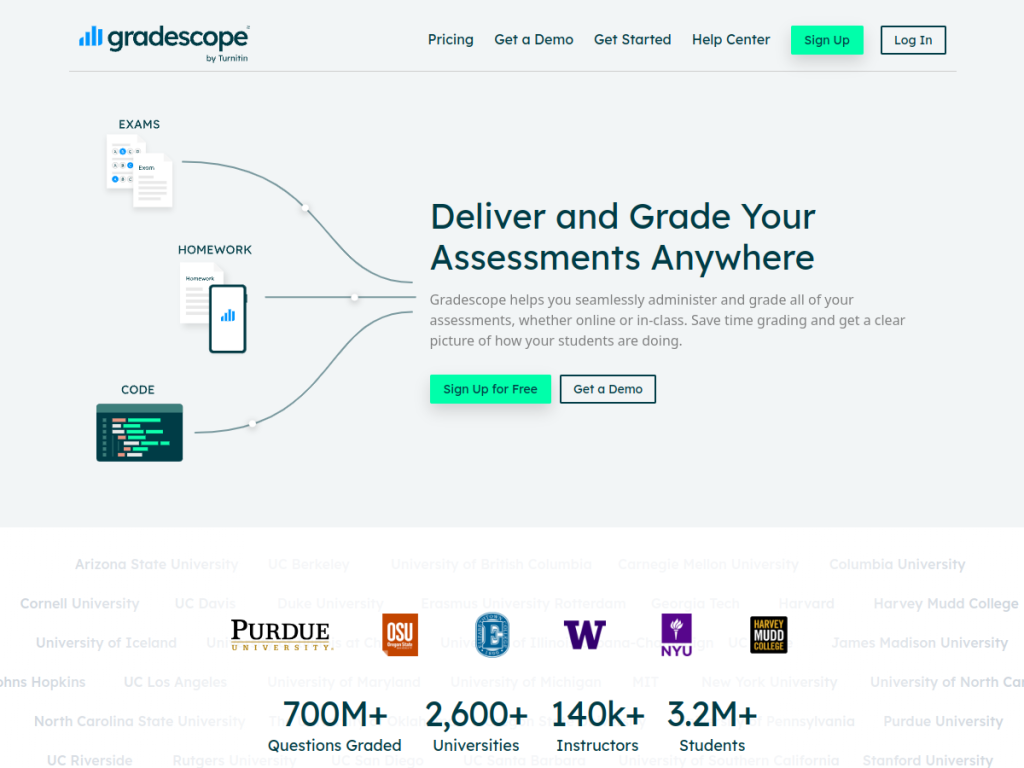
Gradescope is a web-based assessment and grading platform owned by Turnitin that helps educators administer and evaluate student work across many formats. It supports written exams and paper-based assignments, programming projects with code autograders (integrating with GitHub and Bitbucket), homework submissions, and bubble sheets, across disciplines from computer science and math to biology and economics. Its grading capabilities include flexible rubric-based evaluation with one-click feedback, AI-assisted answer grouping that clusters similar responses to grade them together, automatic bubble-sheet grading, and inline commenting. It also provides analytics such as per-question and per-rubric statistics and performance insights by student and concept, plus grade export to external gradebooks, document scanning for paper submissions, instant feedback, and online regrade requests. Gradescope reports use by over 140,000 instructors across 2,600-plus universities, and is typically licensed through institutions.
What it does well
- Many formats: exams, homework, code, and bubble sheets.
- AI-assisted grouping: grade similar answers together, consistently.
- Rubric-based: one-click feedback and fair, structured scoring.
- Analytics: per-question and per-concept performance insights.
Who it is for
Gradescope fits instructors, teaching teams, and institutions — at universities, colleges, and secondary schools, across STEM and non-STEM subjects — that want to grade large volumes of student work faster and more consistently, with helpful analytics. Its code autograders suit computer-science courses, while rubric-based grading helps any subject. Individual tutors with only a handful of submissions may not need it, and it is generally licensed institutionally, but for educators grading at scale who want speed, consistency, and insight, Gradescope is a capable, widely adopted choice.
Things to keep in mind
- It is typically licensed through institutions rather than individually.
- AI-assisted grouping speeds grading but still needs instructor judgment.
- Getting started involves setting up assignments and rubrics.
Our verdict
Gradescope is a well-established, capable grading platform, and its strengths — supporting exams, homework, code, and bubble sheets, with AI-assisted answer grouping and flexible rubrics — genuinely speed up grading while keeping feedback consistent and fair. Analytics on performance by question and concept add real teaching value, and its adoption across thousands of universities speaks to its reliability. It is usually licensed institutionally and still needs instructor judgment, but for educators grading at scale, Gradescope is an excellent, proven choice.
Frequently asked questions
What is Gradescope?
Gradescope is an AI-assisted grading platform, owned by Turnitin, that helps educators grade exams, homework, code, and bubble sheets faster and more consistently.
How does Gradescope use AI?
It uses AI-assisted answer grouping to cluster similar responses so they can be graded together consistently, alongside rubric-based grading and analytics.
What can Gradescope grade?
It grades written exams, homework, programming projects (with autograders), and bubble sheets across many subjects, with grade export to gradebooks.
Who uses Gradescope?
It is used by instructors and institutions — over 140,000 instructors across 2,600+ universities — at universities, colleges, and secondary schools.
Top Gradescope alternatives
Other hand-reviewed Education tools worth comparing against Gradescope.
Ada HealthFree
Ada Health is a free AI education and healthcare tool for healthcare providers. Our review covers what it…
Buoy HealthFree
Buoy Health is a free AI education and healthcare tool for healthcare providers. Our review covers what it…
ChatPDFFreemium
ChatPDF is a freemium AI education and pdf-tool tool for document-heavy teams. Our review covers what it does,…
Connected PapersFreemium
Connected Papers is a freemium AI education and research tool for researchers. Our review covers what it does,…
Coursera AIFreemium
Coursera AI is a freemium AI business and education tool for students and educators. Our review covers what…
Duolingo MaxFreemium
Duolingo Max is a freemium AI education and translation tool for students and educators. Our review covers what…
Are you the maker of Gradescope?
Show visitors this review with the badge below. Copy the code into your site or press kit; it links straight back to this page.